
Could one seven-channel power amplifier give a substantial Bowers & Wilkins cinema system the drive it deserved? That was the appeal of the Arcam FMJ P777 when I brought together my system around 2009. Arcam introduced it that year as the successor to the P7, continuing its approach of putting seven serious amplifier channels in one chassis. With 803D floorstanders, an HTM2D centre and an original Velodyne DD15 subwoofer, I had a system that made dedicated amplification a worthwhile proposition.
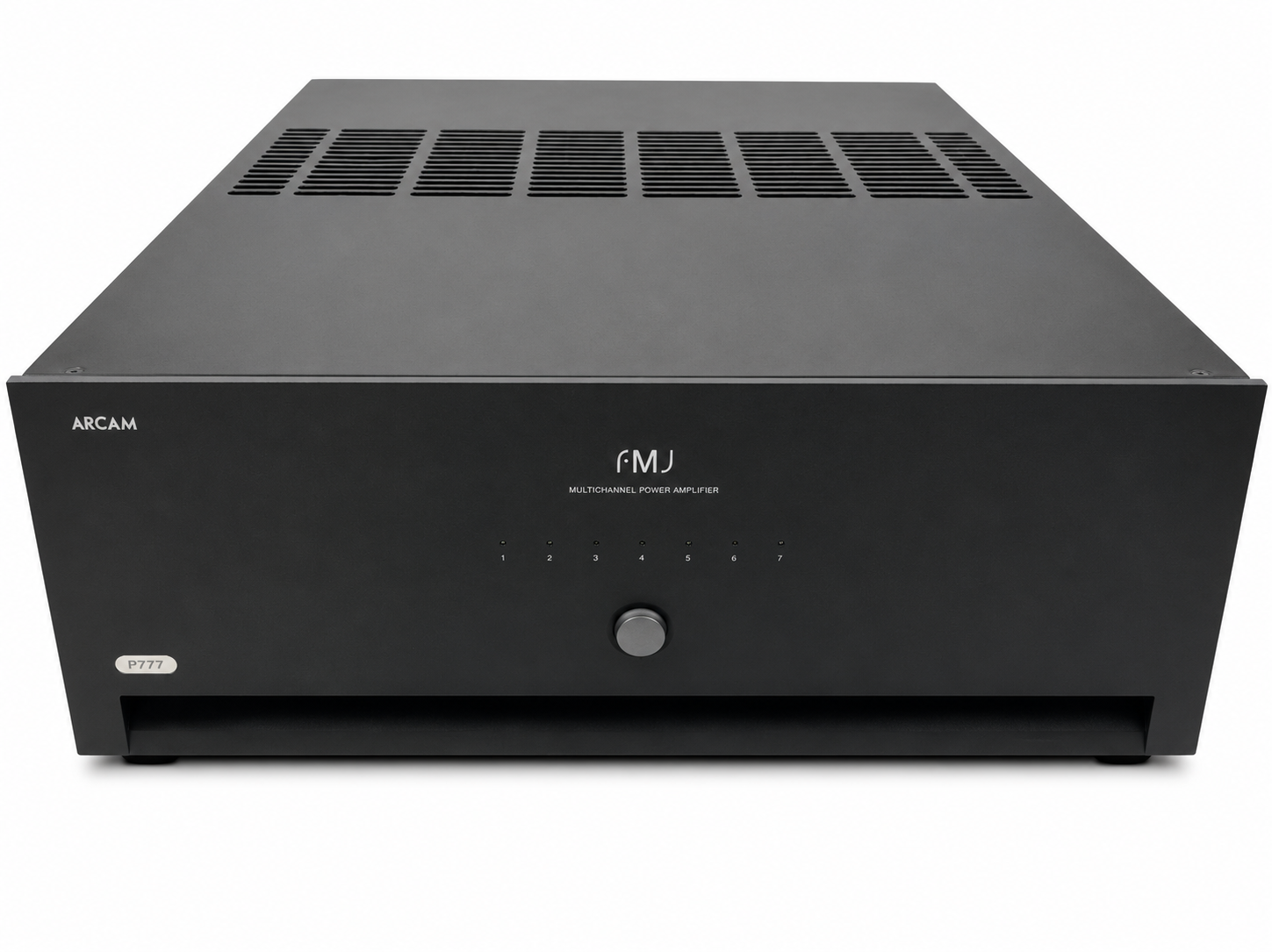
My lasting impression of the P777 is straightforward: it sounded fantastic, had plenty of power and was easy to operate. Those qualities belong together. A cinema system already has enough settings to occupy an evening; once connected, the power amplifier should let you get on with watching a film. The P777's simple front panel suited that role, with a power button and individual channel indicators giving it an uncomplicated presence in the rack.
How the P777 moved on from the P7
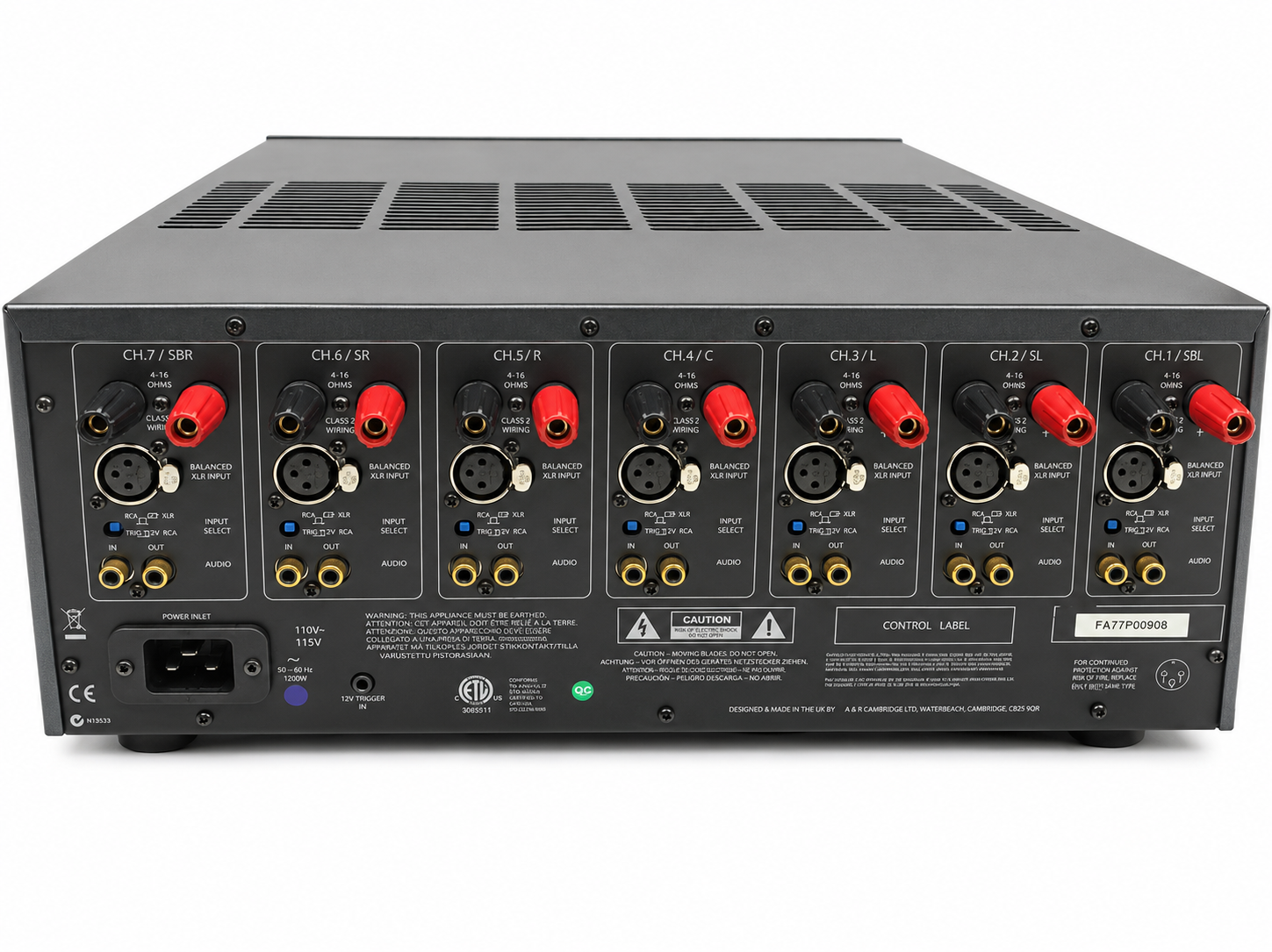
The most obvious change was the addition of balanced XLR inputs for all seven channels, alongside the RCA inputs and loop-through outputs. That gave owners more flexibility when choosing a processor and running cables through a busy equipment rack. It was a practical improvement for a component intended to remain in a system through several generations of processing electronics.
There were electrical changes too. Arcam specified peak output current of 30 amps per channel for the P777, compared with 25 amps for the P7. Voltage gain changed from the P7's approximately 29 dB to Arcam's usual 31.5 dB, relevant when matching levels with other amplifiers. The underlying arrangement of seven isolated amplifier modules with separate transformer windings was carried forward. Sanken output devices were also part of the earlier design, so their presence alone should not be mistaken for a new invention in the P777.
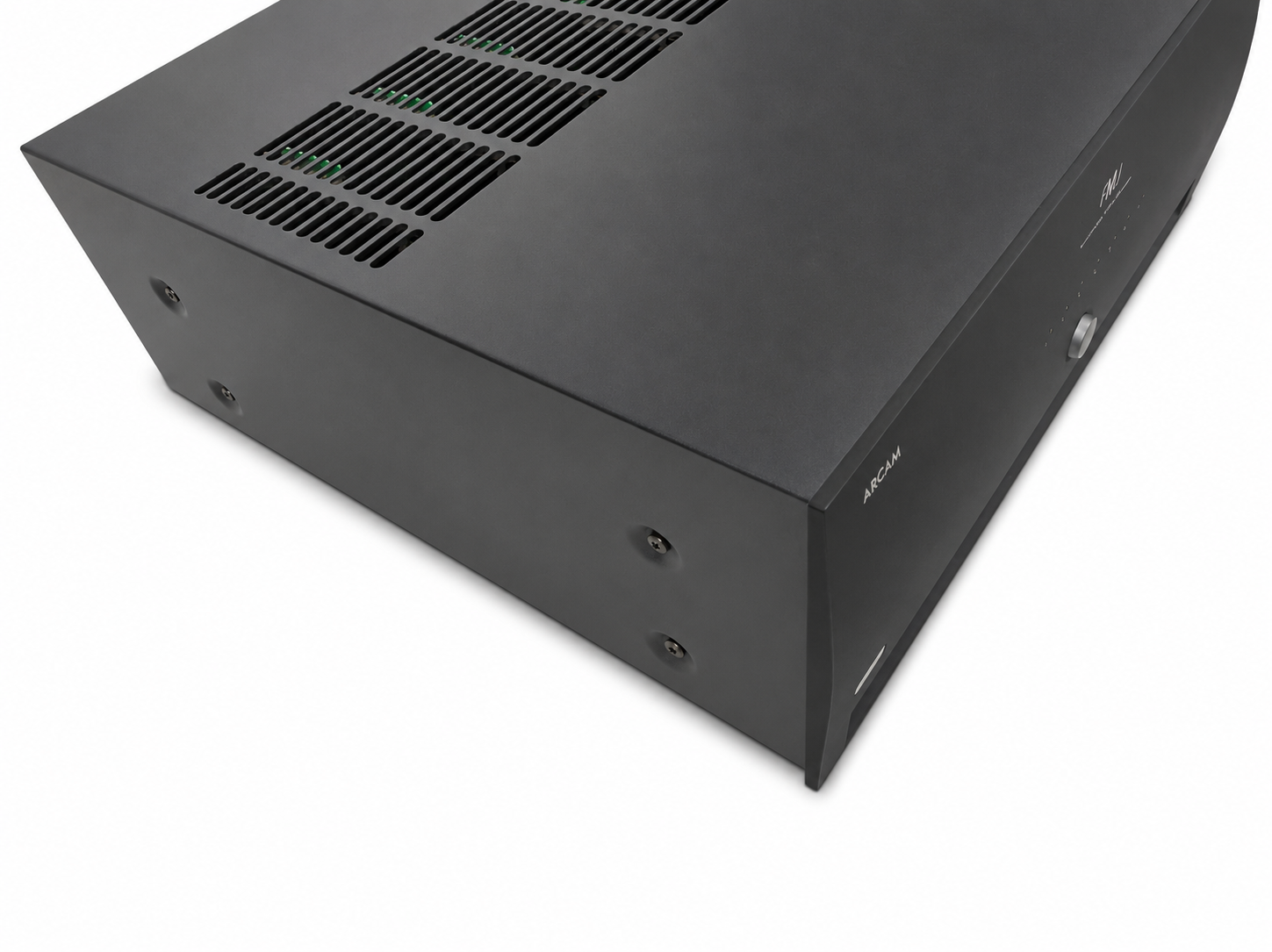
Arcam's product-page ratings were 150 watts per channel into eight ohms and 230 watts into four, with all seven channels driven across 20 Hz–20 kHz. Those conditions matter in a cinema amplifier, where several speakers can demand power together. They also show why the P777 deserves consideration beyond its model number: the development was about connectivity and circuit refinement, rather than simply doubling a headline wattage figure.
The system around it
The 803Ds and HTM2D provided the front speakers, while the Velodyne was the original DD15, before the later Plus model. I crossed the sub in at approximately 60 Hz. Its own amplifier handled the subwoofer. That distinction matters when discussing action films: the deepest effects bass was part of the whole system's performance, and cannot be credited to the P777 alone. The Arcam's job was to drive the passive loudspeakers while working with the processor's channel levels and bass management.
The two films below place this review firmly in that period. Both were already available on Blu-ray by 2009. The discs I used carried DTS-HD 5.1 soundtracks.
Films from the Blu-ray years

Film: Casino Royale (2006)
Director: Martin Campbell
Scene: Madagascar construction-site chase
Source: Blu-ray
Picture: 1080p
Format: DTS-HD 5.1
The sequence I associate with Casino Royale is the full Madagascar pursuit through the construction site. Bond chases Mollaka across the unfinished building and high above the ground, with heavy machinery and physical impacts adding to the urgency. It is a wonderfully sustained piece of action, with changes of height, distance and location that give a cinema system more to communicate than sheer loudness.
What makes it relevant to the P777 is the relationship between scale and intelligibility. The front speakers must give the action substance while leaving the different sounds recognisable. My recollection of the Arcam's power and straightforward character fits that kind of cinema use. The DD15 supplied the separate low-frequency foundation; the amplifier driving the B&Ws still had an important part to play above it.

Film: Pirates of the Caribbean: At World’s End (2007)
Director: Gore Verbinski
Scene: The maelstrom battle
Source: Blu-ray
Picture: 1080p
Format: DTS-HD 5.1
For At World's End, the climactic maelstrom battle captures the scale of the film. The Black Pearl and Flying Dutchman circle through the storm as cannon fire, breaking timber, voices and Hans Zimmer's score compete for attention. The scene builds its excitement through overlapping activity, rather than a succession of isolated explosions.
That makes it an apt example of why I wanted substantial multichannel amplification. The centre has to carry voices within the spectacle, the front pair supplies width and weight, and the surround channels sustain the environment. The P777's identical channel modules made sense in that setting: each speaker had the same basic amplifier design behind it. The point of a system like this was to enjoy the whole scene, including the moments between its biggest impacts.
Living with the Arcam
A P777 needs a strong shelf, ventilation and room behind it for the connections. Seven sets of speaker cables deserve clear labels before the amplifier goes into place. Its balanced and unbalanced inputs, together with a 12-volt trigger, make it adaptable, but its size is a real ownership consideration. I would also check every channel and the cooling system when assessing a used example today.
Was it the right amplifier for my B&W cinema system? Yes. I remember the P777 for its power, enjoyable sound and ease of use. It also remained part of my later B&W journey alongside Classé electronics, which says something about the usefulness of a dedicated power amplifier. For the system I had around 2009, it was a convincing foundation: substantial enough to take the speakers seriously, and simple enough to let the films take over.
Specifications
Manufacturer specifications. Power ratings below follow Arcam’s product page; its handbook gives different power figures, and the published weight also differs between the two documents.
| Specification | Details |
|---|---|
| Type | Seven-channel Class AB power amplifier |
| Rated output, 8 Ω | 7 × 150 W, all channels driven, 20 Hz–20 kHz |
| Rated output, 4 Ω | 7 × 230 W, all channels driven, 20 Hz–20 kHz |
| Power supply | Two 1500 VA toroidal transformers; separate channel windings |
| Analogue inputs | Balanced XLR and unbalanced RCA for each channel |
| Line outputs | RCA loop-through for each channel |
| Control | 12 V trigger input via 3.5 mm mono socket |
| Dimensions (W × H × D) | 435 × 185 × 460 mm |
| Weight | 31 kg on Arcam’s product page; 37.2 kg in the handbook |
| Finishes | Black or silver |