
I love what Scott LaFaro does on Portrait in Jazz. His bass has a strong groove, but the melodic freedom is just as appealing. On Peri’s Scope, I can give him my attention without losing the piano or drums. The parts stay distinct as the music gets more involved, and that sense of space was one of the first things that struck me.
Bill Evans, LaFaro and Paul Motian recorded this, their first studio album together, in New York on 28 December 1959. It was released the following year. The relationship we now associate with this trio was still being established, which makes the assurance of the playing all the more interesting.
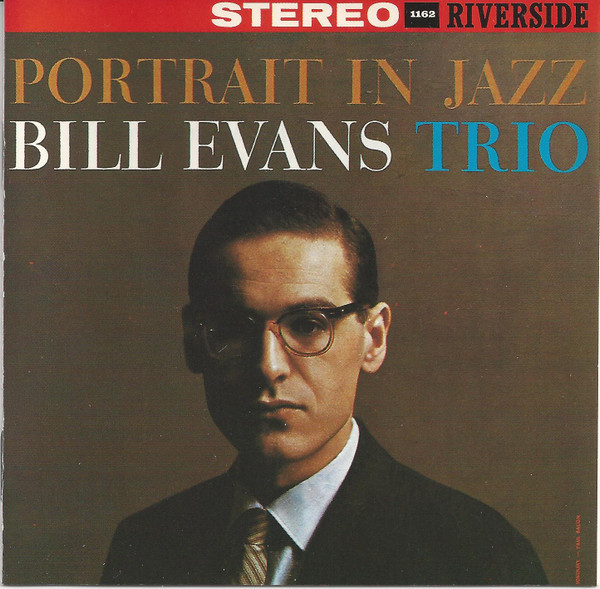
Evans’s aim comes through plainly in the original liner notes. He wanted the musicians to improvise together, with the bass free to answer an idea instead of waiting patiently behind the piano. That helps explain why I enjoy being able to follow the separate parts here. There’s a musical reason to want that clarity. LaFaro has something to say, and I want to hear it.
There’s tension and release in LaFaro’s playing. He gives me more to follow than a succession of low notes marking out the harmony. With the space around the instruments on this recording, his part remains easy to pick out without feeling detached from the others.
Motian takes a quieter approach. I like the subtlety of his drumming and the solid foundation it gives Evans and LaFaro. His cymbals are a particular pleasure; the decay particularly impresses me. It’s the sort of detail that can pass unnoticed when attention stays fixed on the piano, yet it contributes so much to how natural the recording feels.
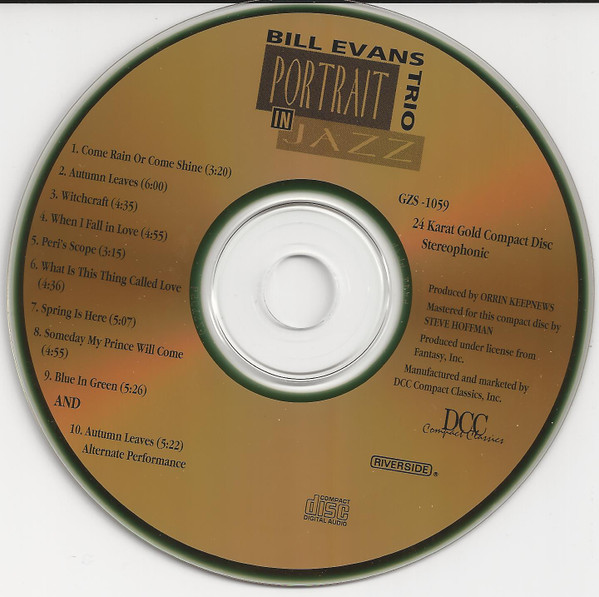
And the piano deserves that attention. Evans’s delicate touch and sense of melody are beautiful here. The solos can be technically impressive, but I find the sensitivity of his playing every bit as striking. On “Peri’s Scope”, an Evans composition, the clarity lets me follow the more complex passages while still enjoying the tune. I don’t want to spend the whole performance untangling which player is doing what.
My copy is the 1994 US DCC 24K Gold CD release, GZS-1059, mastered by Steve Hoffman. I find the sound warm, detailed and lifelike, with a wide, deep soundstage and natural separation. There’s a broad sense of dynamics too. Those qualities let me enjoy the sensitivity of Evans’s playing as well as the busier passages.
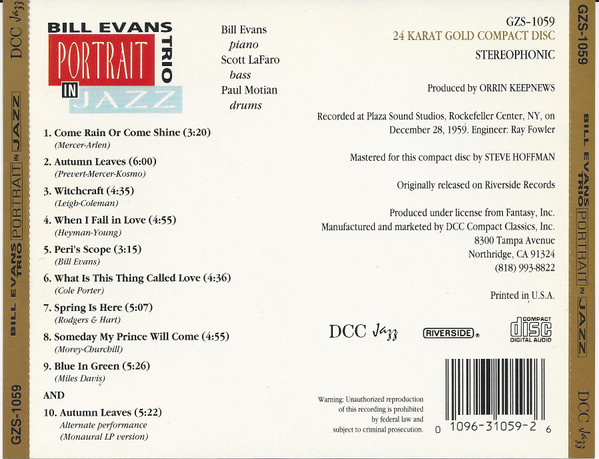
Much of the programme draws on familiar songs, including “Autumn Leaves”, “Come Rain or Come Shine” and “Someday My Prince Will Come”. The liner notes point to “Autumn Leaves” when discussing Evans and LaFaro’s interaction. That was already part of the group’s intention at this first studio date, rather than something attached to the record years later by its reputation.
There’s plenty to admire in Evans’s solos. Keep an ear on LaFaro and Motian as well, though. Being able to follow what they contribute is a large part of why this recording works so well for me.