
Art Blakey & The Jazz Messengers
Moanin’.
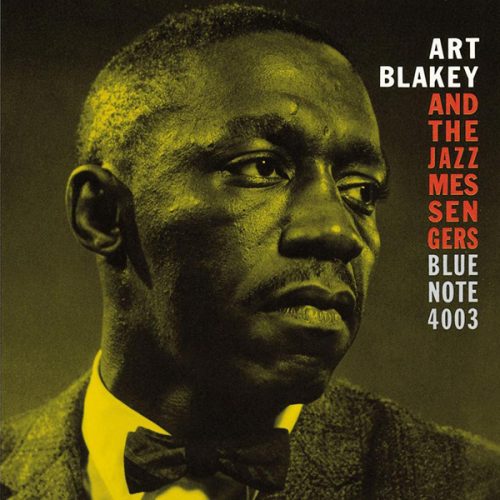
Bobby Timmons and Benny Golson supplied the compositions that made Art Blakey’s Moanin’ a defining document of one Jazz Messengers quintet.
The drummer’s band, the writers’ tunes
Art Blakey led Moanin’ from the drums, but the programme placed his bandmates’ writing at its centre. Pianist Bobby Timmons supplied the opening title track, while tenor saxophonist and musical director Benny Golson contributed four compositions. Trumpeter Lee Morgan and bassist Jymie Merritt completed the quintet. The session brought those five musicians together under Blakey’s leadership for a six-selection album.
The Jazz Messengers had begun as a partnership between Blakey and pianist Horace Silver. After Silver left in 1956, Blakey continued the group with changing personnel, drawing new repertoire from incoming musicians. Moanin’ records one particular stage of that history, with Golson’s compositions and Timmons’s title piece forming most of the programme.
Four Golson pieces and a drummer’s suite
Golson’s contribution extends beyond “Blues March” and its military-style drum opening. “Are You Real” and “Along Came Betty” sit alongside “The Drum Thunder Suite”, written as a three-movement feature for Blakey. Its themes are “Drum Thunder”, “Cry a Blue Tear” and “Harlem’s Disciples”. The suite occupies one place in the original LP sequence, even though its three sections are separately named.
The closing selection, “Come Rain or Come Shine”, brings Harold Arlen and Johnny Mercer’s song into a programme otherwise written by Timmons and Golson. That division of authorship is part of the album’s identity: the band’s pianist and saxophonist supplied five selections, while the final performance draws on the established song repertoire.
Hackensack, then the reissue studios
Alfred Lion produced the recording at Rudy Van Gelder’s Hackensack studio on 30 October 1958. Van Gelder handled recording, with Leonard Feather credited for the original liner notes. The album appeared on Blue Note in 1959, with BLP 4003 identifying the mono edition and BST 84003 the stereo. The recording location was Hackensack, before the later Van Gelder studio in Englewood Cliffs.
Later editions document separate production work. The 1999 RVG CD credits Van Gelder’s 1998 remaster and 24-bit analogue-to-digital transfers. The 2009 SACD credits Kevin Gray and Steve Hoffman for mastering at AcousTech, followed by Gus Skinas’s SACD authoring on the Sonoma system. The 2021 vinyl edition credits Gray at Cohearent Mastering. These dates and roles identify the later editions, while the original session remains the 1958 quintet recording.
Across those formats, the original programme keeps the same balance: Timmons opens the album, Golson provides its largest share of compositions, and Blakey leads the band that connects them.
Track list
| No. | Track | Top pick |
|---|---|---|
| 1 | Moanin' | ✓ |
| 2 | Are You Real | |
| 3 | Along Came Betty | |
| 4 | The Drum Thunder Suite (Drum Thunder / Cry a Blue Tear / Harlem’s Disciples) | |
| 5 | Blues March | ✓ |
| 6 | Come Rain or Come Shine |
Recommended versions
Vinyl: 2021 Blue Note (0746568 / 00602507465681 / BST-84003 / BST 84003 / ST-84003 / 84003, Worldwide). In 12,391 Discogs collections. Community rating: 4.74/5 from 1,304 votes. View this Vinyl edition ↗
CD: 1999 Blue Note (7243 4 95324 2 7, Europe). In 2,074 Discogs collections. Community rating: 4.62/5 from 205 votes. View this CD edition ↗
SACD: 2009 Analogue Productions (CBNJ 84003 SA / 509996-97212-2-9 / 4003 / BLP 4003 / BLP-4003, US). In 217 Discogs collections. Community rating: 4.71/5 from 34 votes. View this SACD edition ↗
Album details
| Original release | 1959 |
|---|---|
| Label / original catalogues | Blue Note; BLP 4003 (mono); BST 84003 (stereo) |
| Genre | Jazz; hard bop |
| Recorded | 30 October 1958; Van Gelder Studio, Hackensack, New Jersey |
| Musicians | Art Blakey: drums; Lee Morgan: trumpet; Benny Golson: tenor saxophone; Bobby Timmons: piano; Jymie Merritt: bass |
| Composers | Bobby Timmons; Benny Golson; Harold Arlen and Johnny Mercer |
| Producer | Alfred Lion |
| Recording engineer | Rudy Van Gelder |
| Original liner notes | Leonard Feather |
| Tracks | 6 original LP selections; Drum Thunder Suite contains three movements |
Sources: Blue Note Records album spotlight; Capitol Records archive; original and reissue sleeve credits reproduced on Discogs; Rudy Van Gelder Legacy discography.