
KEF
LS LUXE.
KEF’s LS LUXE combines a sculpted Ross Lovegrove cabinet with cone-velocity feedback, current-drive amplification and a larger Uni-Q array.
The KEF LS LUXE measures its own cone movement. A velocity sensor feeds information back to the amplifier, allowing the system to correct differences between the requested signal and the driver’s movement in real time. KEF calls this Velocity Control Technology, or VECO, and attributes reduced distortion and compression to the arrangement as output rises.
Introduced in 2026, this active wireless stereo system builds on the LS50 Wireless II as a step up in the range. It combines a larger Uni-Q array, current-drive amplification and VECO with a sculpted cabinet by Ross Lovegrove. KEF describes the relationship as development of its compact active platform, rather than identifying the LS LUXE as a replacement for every earlier model.
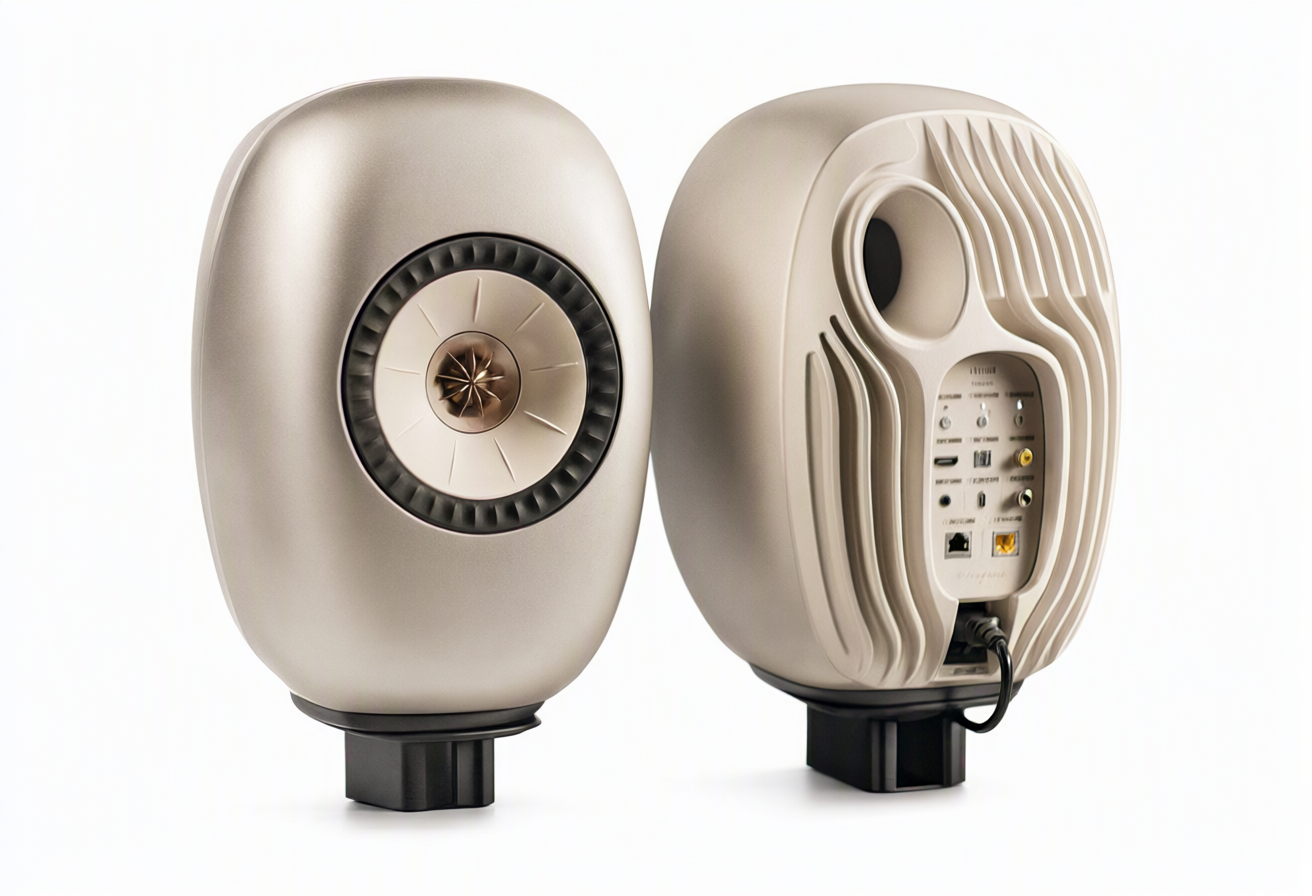
The driver and amplifier form one system
The twelfth-generation Uni-Q places a one-inch aluminium-dome tweeter at the acoustic centre of a 6.5-inch aluminium low/mid-frequency driver. The shared acoustic centre is part of KEF’s coaxial driver architecture. Metamaterial Absorption Technology works behind the tweeter, while the larger surrounding cone handles the lower-frequency portion of this two-way system.
Each speaker contains a 280-watt Class D amplifier for the low/mid-frequency section and a 100-watt Class AB amplifier for the tweeter. These ratings describe the individual internal channels in each cabinet. The amplifiers are designed as part of the active loudspeaker, with the driver processing and correction implemented within the same system.
Why sense motion as well as process the signal?
VECO uses feedback from actual cone velocity rather than relying on the incoming audio signal alone. The sensor provides information about the moving driver while the amplifier is operating. KEF combines this with current-drive amplification, identifying the two as a linked part of the LS LUXE design. Its claimed reductions in distortion and compression relate to that controlled driver behaviour.
The system also uses KEF’s Music Integrity Engine for digital signal processing. This gives the loudspeaker distinct processing and feedback functions: DSP manages the signal, while VECO responds to movement. The design therefore goes beyond putting conventional amplifiers inside a passive cabinet, with the conversion, amplification and driver behaviour considered together.
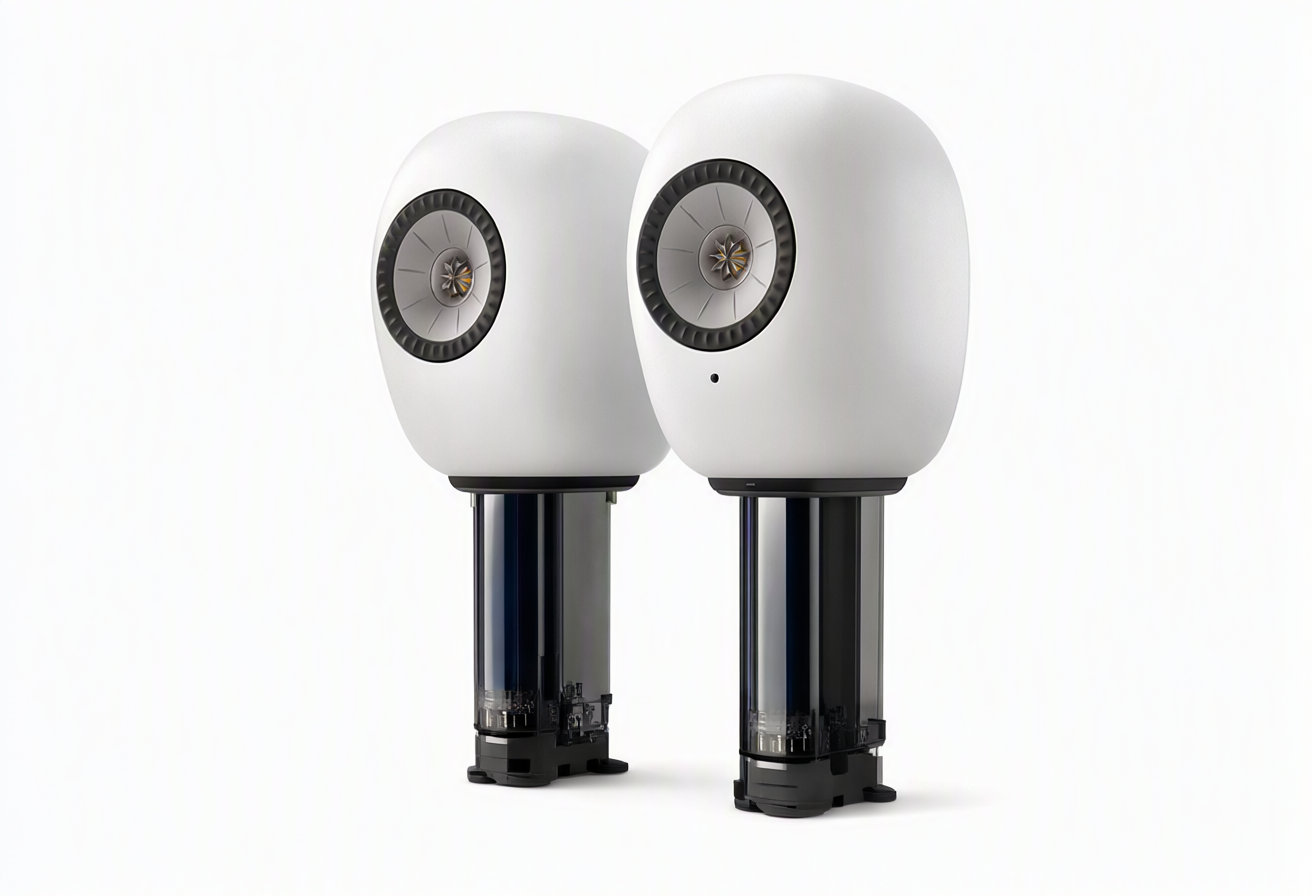
A sculpted enclosure with an engineering role
Lovegrove’s cabinet uses a high-strength composite material and a smooth form developed with acoustic diffraction in mind. KEF also specifies a flexible decoupling chassis for the low/mid-frequency driver and its Flexible Port Technology. These address mechanical coupling and port behaviour around the driver, adding physical measures alongside the electronic correction.
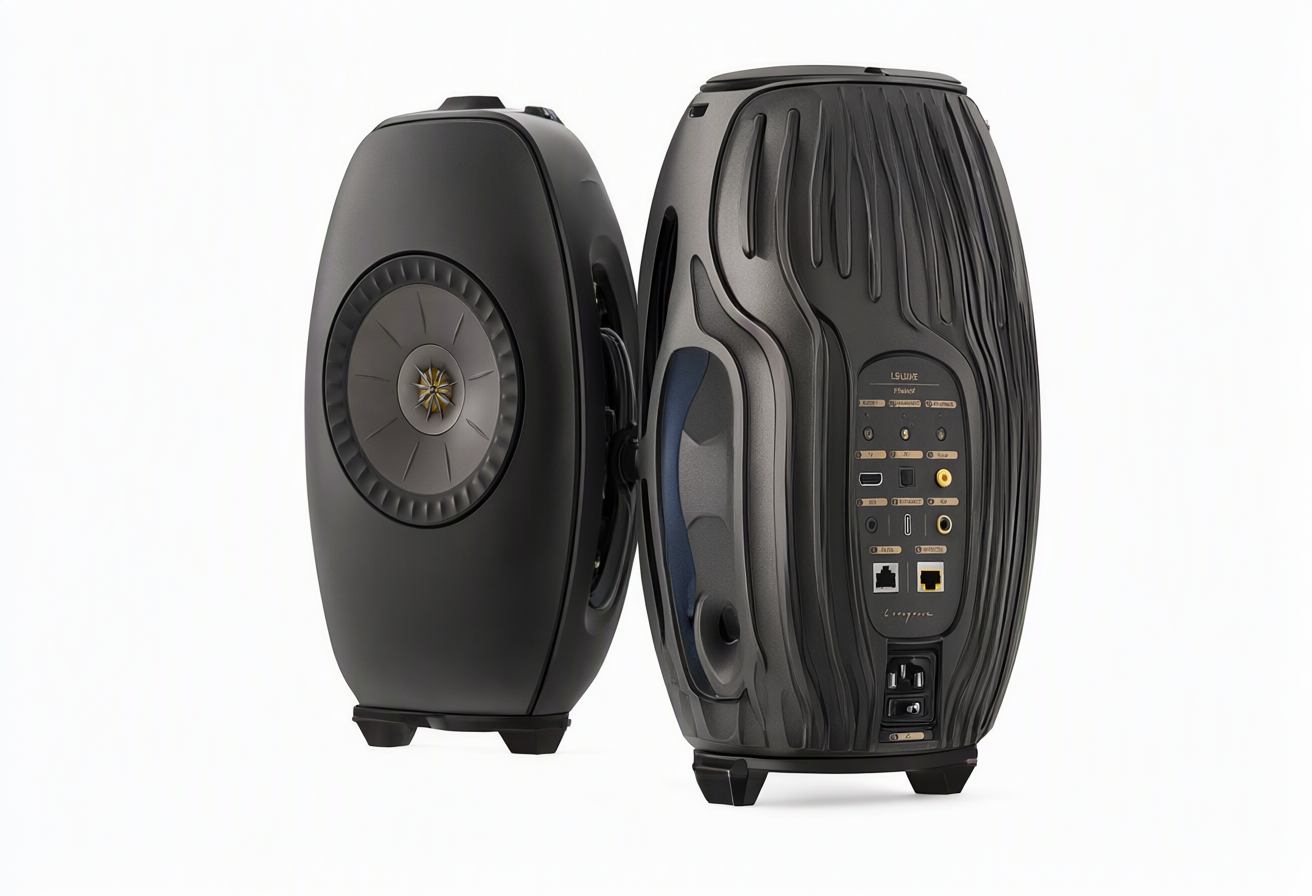
The system is offered in Dusk Titan, Eclipse Black and Mineral White finishes. Each speaker measures 336 mm high, 223 mm wide and 298 mm deep, while the pair weighs 20 kg. The pair weight is separate from the dimensions and amplifier ratings, which are specified per speaker. This is a self-powered stereo pair, with the source and amplification facilities incorporated.
Connections and the link between speakers
HDMI eARC connects a television, while optical, coaxial and analogue auxiliary inputs accommodate other sources. Network playback and wireless streaming add further options. The published network format ceiling is 24-bit/384 kHz, but the link between speakers has its own limits: 24-bit/192 kHz with a wired connection and 24-bit/96 kHz wirelessly.
Those connection limits belong alongside the headline format figure when planning a system. The LS LUXE brings its sources, processing and amplification into the speaker pair, while its defining engineering story remains the feedback loop around the cone. The sculpted form is immediately visible; the sensor, current-drive stages and integrated processing explain the development beneath it.
Specifications
| Specification | Details |
|---|---|
| Type / design | Active wireless two-way stereo speaker system; 12th-generation Uni-Q with MAT |
| Tweeter | 1 × 1-inch aluminium dome per speaker |
| Midrange / bass | 1 × 6.5-inch aluminium low/mid-frequency cone per speaker |
| Frequency response | 42 Hz–28 kHz (±3 dB; EQ-dependent) |
| Amplification | Per speaker: low/mid-frequency 280 W Class D; tweeter 100 W Class AB |
| Inputs | HDMI eARC; optical; coaxial; analogue AUX; network LAN |
| Network resolution | Up to 24-bit/384 kHz; interspeaker wired 24-bit/192 kHz, wireless 24-bit/96 kHz |
| Wireless streaming | AirPlay; Google Cast; Bluetooth 5.3 |
| Dimensions (H × W × D) | 336 × 223 × 298 mm per speaker |
| Weight | 20 kg per pair |
| Finishes | Dusk Titan; Eclipse Black; Mineral White |