Put Albert King and Stevie Ray Vaughan together on “Call It Stormy Monday” and you’ve got my attention. The way they trade solos is a big part of why I like In Session. King’s playing is smooth and soulful. Stevie brings the fire, and neither loses his own voice when they play together.
They’re a bloody good pairing. I like the contrast between them, particularly when Vaughan’s intensity meets King’s easier style. There’s room for both, and the pleasure they take in playing together comes through. All that guitar skill would mean much less to me without the feeling behind it.
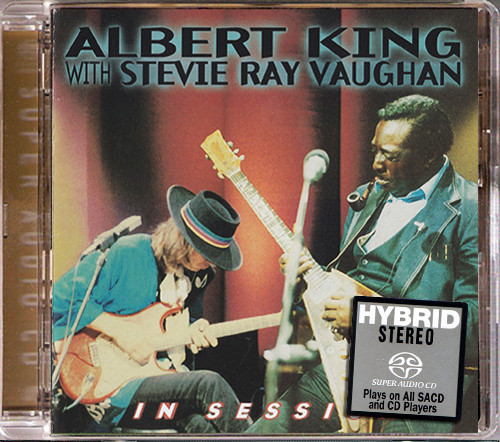
The session dates from 6 December 1983, when they came together at CHCH-TV’s studios in Ontario, Canada. It was recorded for television. Vaughan’s debut, Texas Flood, had come out that year, so this caught him just as a much wider audience was discovering his playing. King was already one of the musicians who had helped shape it.
That gives their meeting some weight. Vaughan was making his name with a style that owed a great deal to King, and here he was playing alongside him. Yet the attraction for me is how well their different approaches work together. I don’t need them to sound alike. The smoothness in King’s playing and the force in Vaughan’s are what make the exchange on “Call It Stormy Monday” so good.
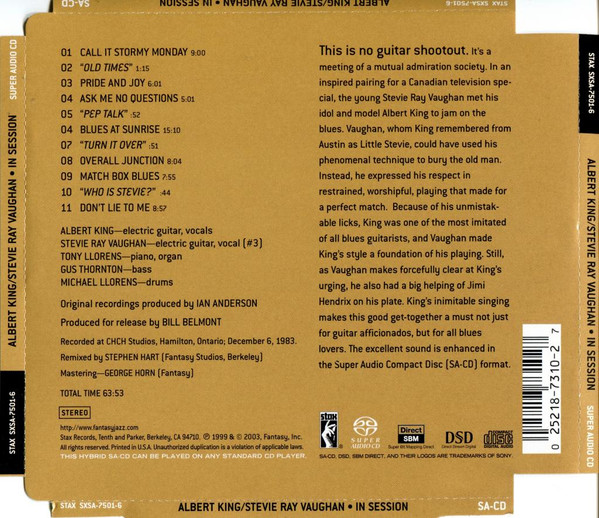
There are other musicians in the room, too. Tony Llorens plays piano and organ, with Gus Thornton on bass and Michael Llorens on drums. The two guitarists get the attention, understandably, but In Session is a band performance. Those credits matter when the cover gives you two famous names and it’s tempting to think only of the guitars.
The talking stays on the record. Between songs, the spoken exchanges let the meeting continue without anyone playing a note. “Old Times” and “Pep Talk” are among those short spoken pieces. They’re part of the programme, which helps explain why the original album’s eleven tracks amount to seven musical performances. The warmth between King and Vaughan carries beyond their solos.
I listened to the 2003 Stax hybrid stereo SACD, SXSA-7501-6, which credits George Horn for mastering. It carries the original seven performances and four spoken tracks. “Call It Stormy Monday” opens it and “Don’t Lie to Me” closes it, so the two performances I like most sit at either end.
For all the attention their guitar playing deserves, King’s singing is a large part of the appeal for me. His voice has depth and power, and “Don’t Lie to Me” is my other highlight. Vaughan’s guitar and King’s vocals work beautifully together here. There’s plenty of energy, with the feeling that both men are enjoying themselves.
Vaughan sings “Pride and Joy”, his only lead vocal on the original album. That leaves plenty of room for King as a singer, which suits me. On “Don’t Lie to Me”, I want that voice every bit as much as I want the guitar playing.
Sixteen years was a long wait for this session to reach an album. It deserved to be heard well beyond its television audience. Having it on record lets us spend time with a meeting that happened at a particularly good moment: Vaughan was finding his audience, and King could hear what the younger man had done with his influence. I’m glad somebody had the tape running.