
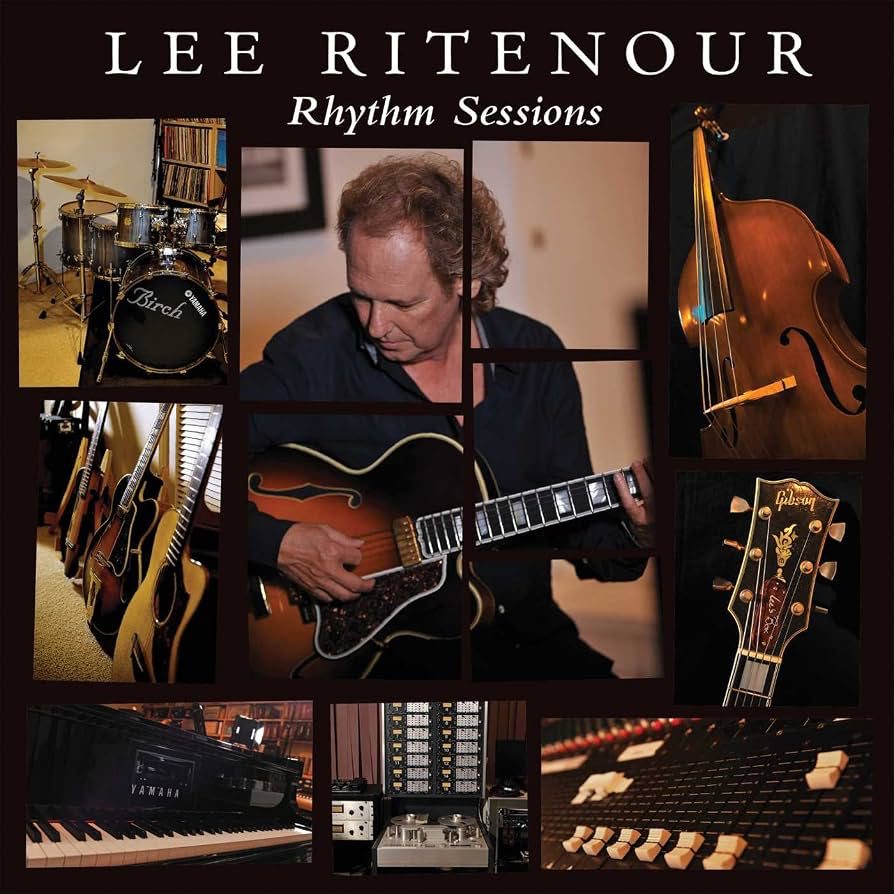
Lee Ritenour
Rhythm Sessions.
Lee Ritenour built Rhythm Sessions around the musicians behind each song, bringing veteran collaborators and competition winners into the same 2012 project.
A week to write the opening track
George Duke, Stanley Clarke and Dave Weckl were available the following week. Ritenour had booked the players but had no music ready for them, so he wrote “The Village”: a 12/8 African shuffle conceived for Clarke’s upright bass, Duke’s Rhodes and Minimoog, and Weckl’s drums. The opening track began with the band, then the composition.
That approach followed 6 String Theory (2010), the all-star project marking fifty years since Ritenour began playing guitar. By then, his career encompassed Los Angeles session work, solo recordings and Fourplay. Rhythm Sessions extended the earlier project’s competition to piano, bass and drums, making recording opportunities part of its purpose. Entries opened in January 2012 and continued into May, within the album’s January–June recording period.
The organisers’ photographs place the rhythm-section winners at Sunset Sound with Ritenour. Pianists Demetrius Nabors and Hans de Wild, bassist Michael Feinberg and drummer Selim Munir perform Grusin’s closing “Punta del Soul”. Their prize brought them into the album itself.
Old partnerships, new combinations
Dave Grusin’s involvement reaches back beyond this record. Ritenour credits him with opening doors in his session career and teaching him production. The pair co-produced their joint albums Harlequin (1985) and Amparo (2008). Here, Grusin plays Rhodes on Nick Drake’s “River Man”, accompanying Kurt Elling alongside Nathan East and Will Kennedy.
The two vocal songs also connect directly with the reel: Elling’s “River Man” and Zamajobe’s version of Stereophonics’ “Maybe Tomorrow”. Ritenour explained his choice of Elling in the Concord notes; for “Maybe Tomorrow”, he described adapting the song around Zamajobe’s voice and a rock-guitar arrangement.
His son Wesley introduced him to E.S.T., the Swedish trio of pianist Esbjörn Svensson, bassist Dan Berglund and drummer Magnus Öström. Wesley plays with Christian McBride on “800 Streets By Feet”; “Spam-Boo-Limbo” pairs John Beasley, Tal Wilkenfeld and Vinnie Colaiuta. Chick Corea also performs, playing piano on his “Children’s Song #1”. Ritenour added a new middle section to its arrangement, which Corea approved. Marcus Miller contributes bass to Herbie Hancock’s “Fat Albert Rotunda”.
From the bicycle to the control room
In Jeff Tamarkin’s M Music & Musicians interview, Ritenour described reviewing home-recorded improvisations while cycling, then returning to develop ideas. The same interview documents Ramirez classical and Roger Sadowsky classical-electric guitars, plus a Roland GR-55 guitar synthesizer. Describing his effects use, he explained: “I don’t use too many effects these days, because the guitar tone has to cut through.”
Sessions used Starlight, Henson, the Village, Sunset Sound and Chronocromie around Los Angeles, and Sear Sound in New York. Additional engineering for “Maybe Tomorrow” took place at Pyramid Studios in Johannesburg. Ritenour produced and arranged; Don Murray mixed and Paul Blakemore mastered. Ariel Mann’s synthesizer and programming credits appear on tracks 1–11.
Beyond the sessions
The album reached No. 8 on JazzWeek’s jazz-radio airplay chart. The competition organisers later documented Hans de Wild performing with Ritenour in Europe and receiving a four-year Berklee scholarship. The final ensemble on “Punta del Soul” gives the project its closing statement: the opportunity to record was part of the music being made.
Track list
| No. | Track | Featured players | Top pick |
|---|---|---|---|
| 1 | The Village | George Duke · Stanley Clarke · Dave Weckl | |
| 2 | River Man | Kurt Elling · Dave Grusin · Nathan East · Will Kennedy | ✓ |
| 3 | Fat Albert Rotunda | Marcus Miller · Patrice Rushen · Deron Johnson | |
| 4 | 800 Streets By Feet | Christian McBride · Wesley Ritenour | |
| 5 | Children's Song #1 | Chick Corea · Chuck Berghofer · Peter Erskine | |
| 6 | LA By Bike | Larry Goldings · Melvin Lee Davis · Sonny Emory | |
| 7 | Maybe Tomorrow | Zamajobe · Tal Wilkenfeld · Vinnie Colaiuta | ✓ |
| 8 | Spam-Boo-Limbo | John Beasley · Tal Wilkenfeld · Vinnie Colaiuta | |
| 9 | July | Larry Goldings · Melvin Lee Davis · Sonny Emory | |
| 10 | Rose Pedals | Dave Grusin · Nathan East · Will Kennedy | |
| 11 | Dolphins Don't Dance | Alan Pasqua · Larry Goldings · Peter Erskine | |
| 12 | Punta del Soul | Demetrius Nabors · Hans de Wild · Michael Feinberg · Selim Munir |
Recommended versions
CD: 2012 Concord Records (0888072337091, Europe). In 222 Discogs collections. Community rating: 4.00/5 from 14 votes. View this CD edition ↗
Album details
| Original release | 25 September 2012 |
|---|---|
| Label | Concord Records |
| Genre | Jazz · contemporary jazz |
| Recording | January–June 2012 · Los Angeles, Hollywood, New York and Johannesburg |
| Guitar, production and arrangements | Lee Ritenour |
| Selected guests | Chick Corea · George Duke · Stanley Clarke · Dave Grusin · Marcus Miller |
| Mixing / mastering | Don Murray / Paul Blakemore |
| Tracks | 12 |
Sources: Lee Ritenour interview by Jeff Tamarkin, M Music & Musicians; Concord album notes; Ritenour’s official discography; Six String Theory competition announcements, photographs and winners archive; JazzWeek, 17 December 2012; European Concord CD credits, catalogue 0888072337091.