
Accuphase
E-6000.
A larger output stage and power supply give the Accuphase E-6000 higher rated power, while ANCC revises its Balanced AAVA volume circuit.
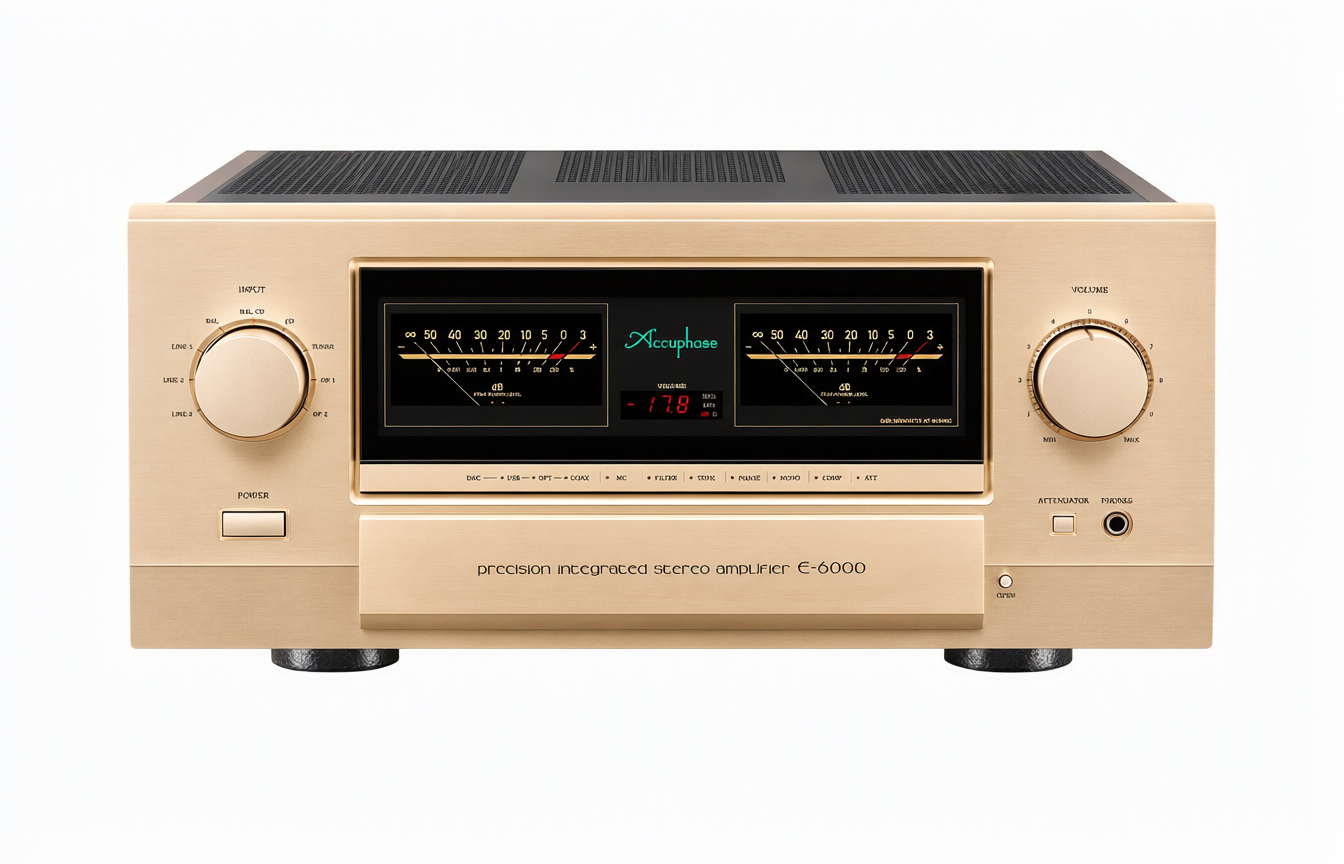
The Accuphase E-6000 develops the E-5000 in two directions: a larger output stage and a revised volume-control circuit. Six parallel push-pull pairs of bipolar transistors serve each channel, replacing five in the earlier model. A larger toroidal transformer and increased reservoir capacitance accompany that change, while Balanced AAVA gains the company’s ANCC noise and distortion cancellation circuitry.
This Japanese-made stereo integrated amplifier combines a balanced preamplifier and Class AB power stage. Its rating is 260 watts per channel into 8 ohms or 350 watts into 4 ohms, with both channels driven across 20 Hz to 20 kHz. The E-5000 figures were 240 and 320 watts respectively, making the output change a defined comparison under the stated loads.
A larger supply and output stage
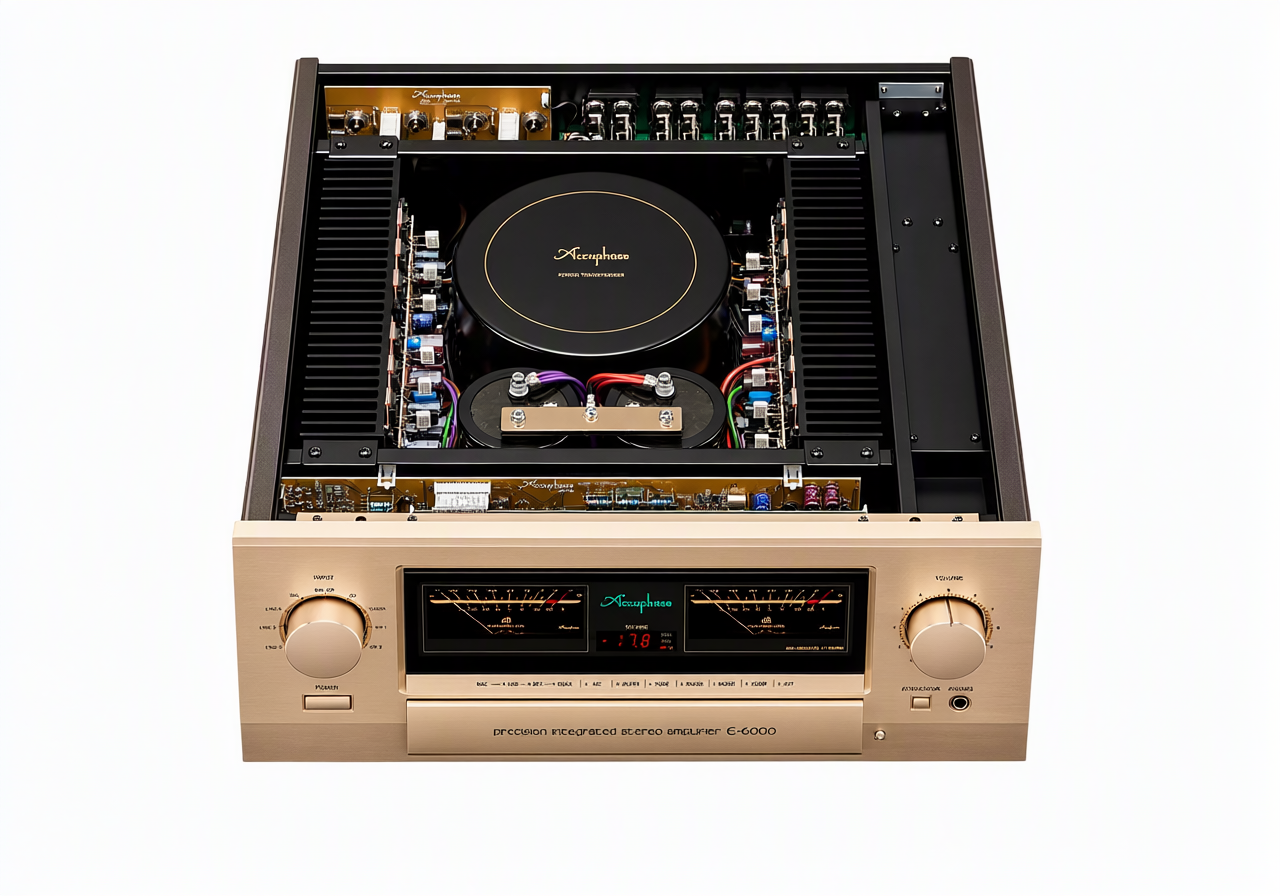
Accuphase identifies a transformer diameter increase of 25 mm relative to the E-5000. Each of the two reservoir capacitors also grows from 40,000 to 47,000 microfarads, with the newer capacitors specified at 100 volts. These supply changes accompany the additional parallel transistor pair on each side, forming the company’s hardware explanation for the increased rated output.
The power stage uses an instrumentation-amplifier configuration and current feedback. Large heatsinks sit beside the output stages, while MOSFET switches form part of the loudspeaker protection arrangement. Accuphase specifies a damping factor of 1,000 and uses balanced remote sensing. Its explanation connects the output-stage layout, feedback arrangement and protection connections rather than attributing speaker control to rated wattage alone.
What the volume control changes
Balanced AAVA adjusts level by combining signals rather than placing a conventional variable resistor in the audio path. ANCC is applied to its current-to-voltage conversion amplifier. Accuphase describes a secondary amplifier cancelling noise and distortion from the main amplifier, with the intended improvement particularly relevant between low and typical listening-volume positions.
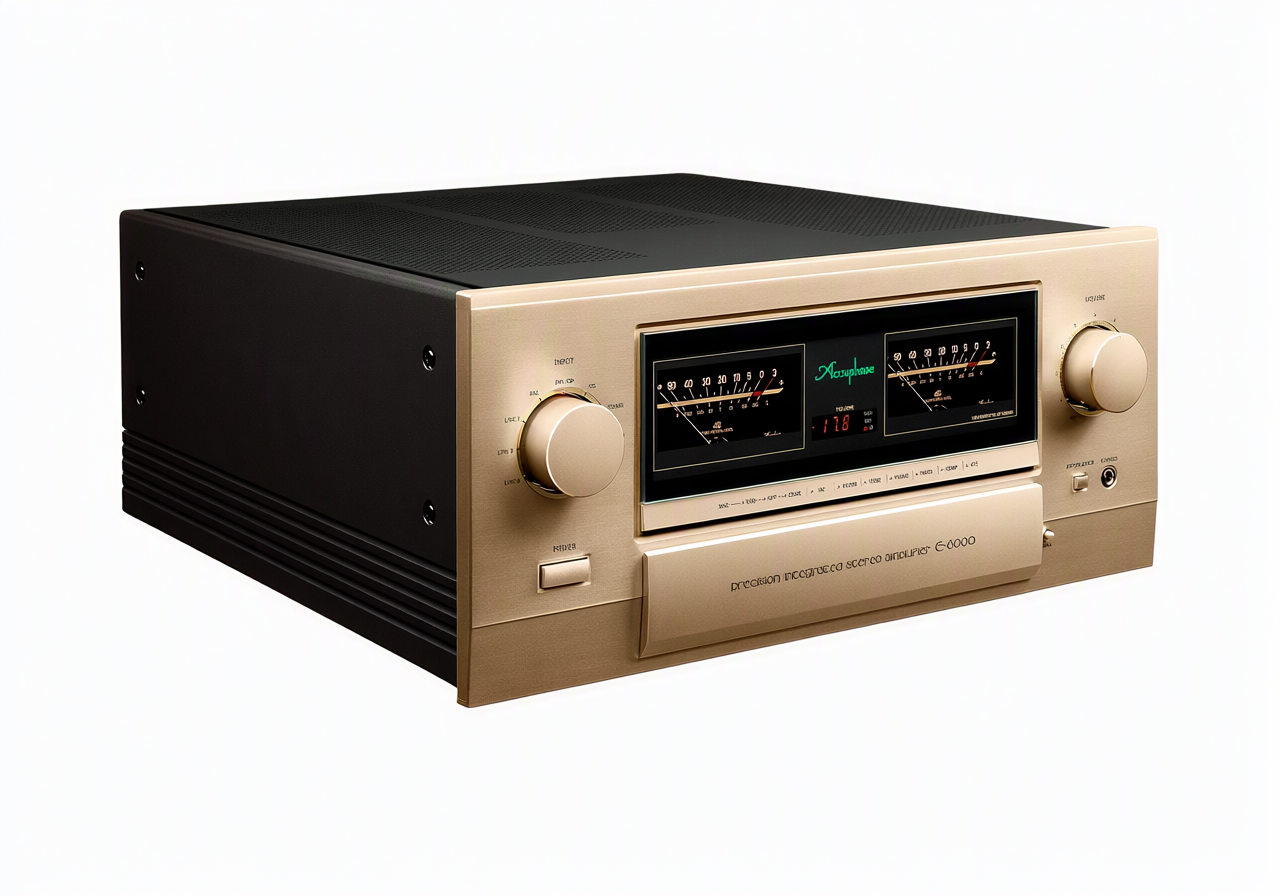
The front volume knob still gives the user a familiar physical control, but its sensor mechanism and the audio-level circuit have different roles. The sensor assembly is machined from an aluminium block for rigidity and position detection. Remote operation controls the same system. The revised circuit therefore sits behind a conventional-looking knob without making that knob the audio attenuator itself.
Analogue inputs with room for options
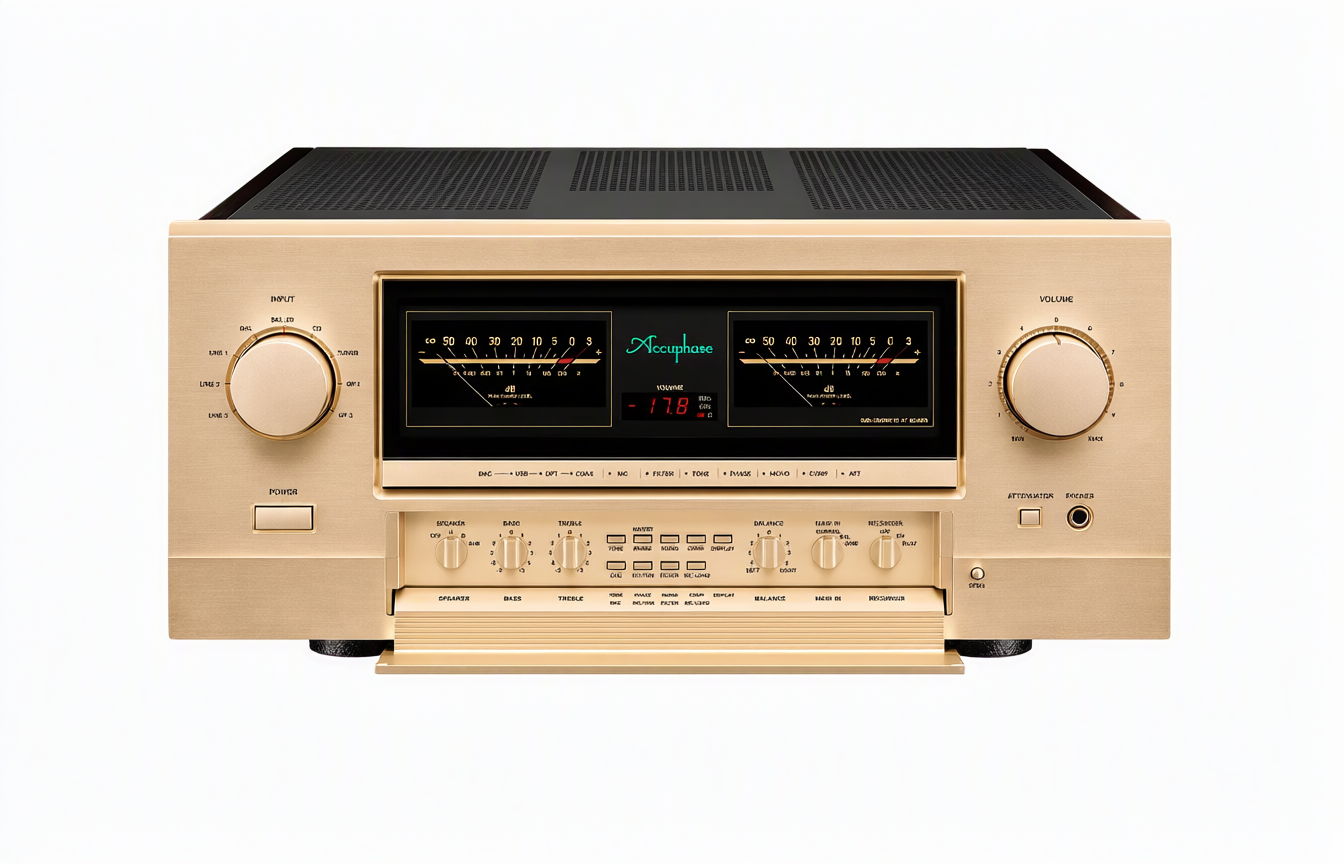
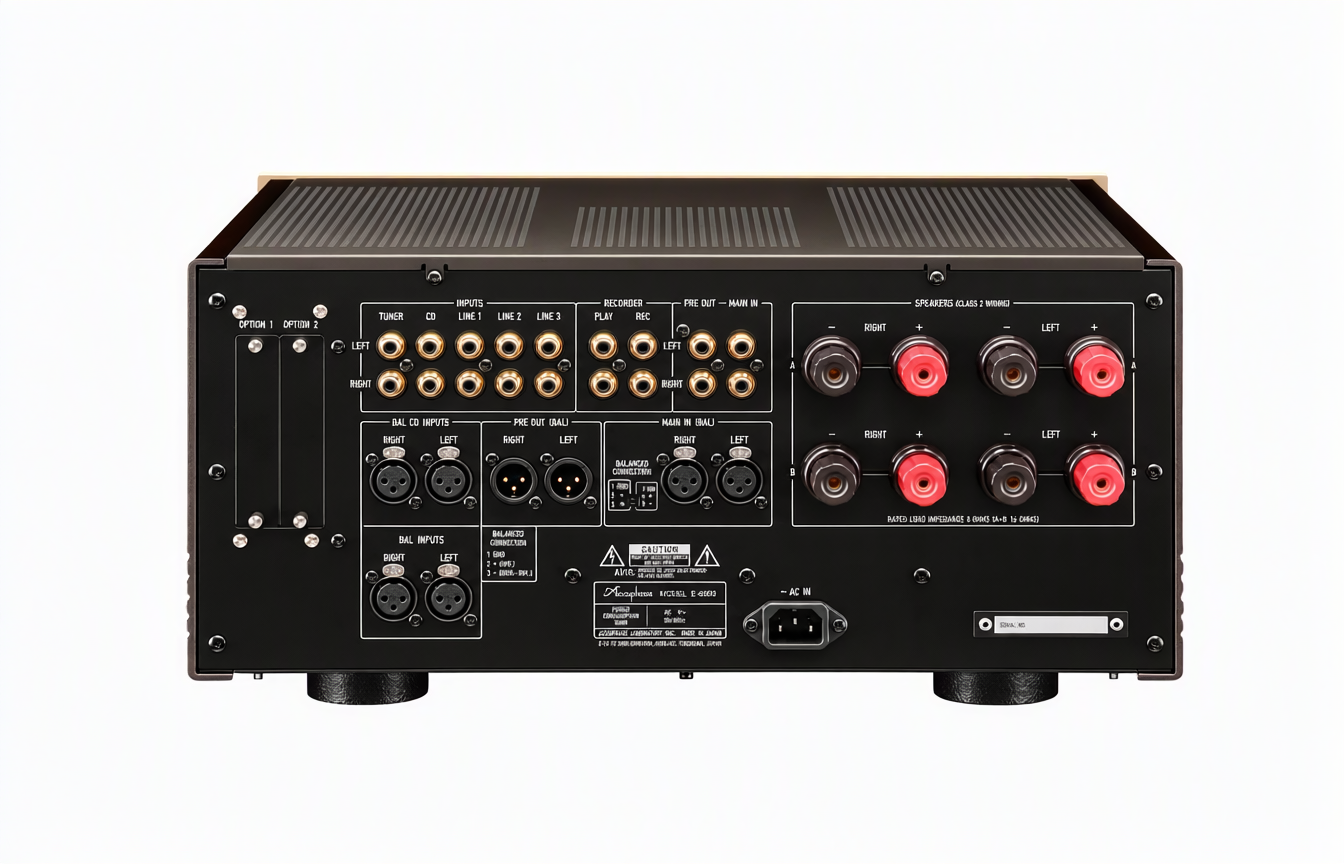
Five RCA line inputs and two balanced inputs provide the standard analogue source connections. Preamplifier outputs and separate power-amplifier inputs are available in line and balanced forms, allowing the integrated sections to participate in a larger system. Front controls include balance, bass and treble adjustment, loudness compensation and attenuation, alongside the input selection and volume display.
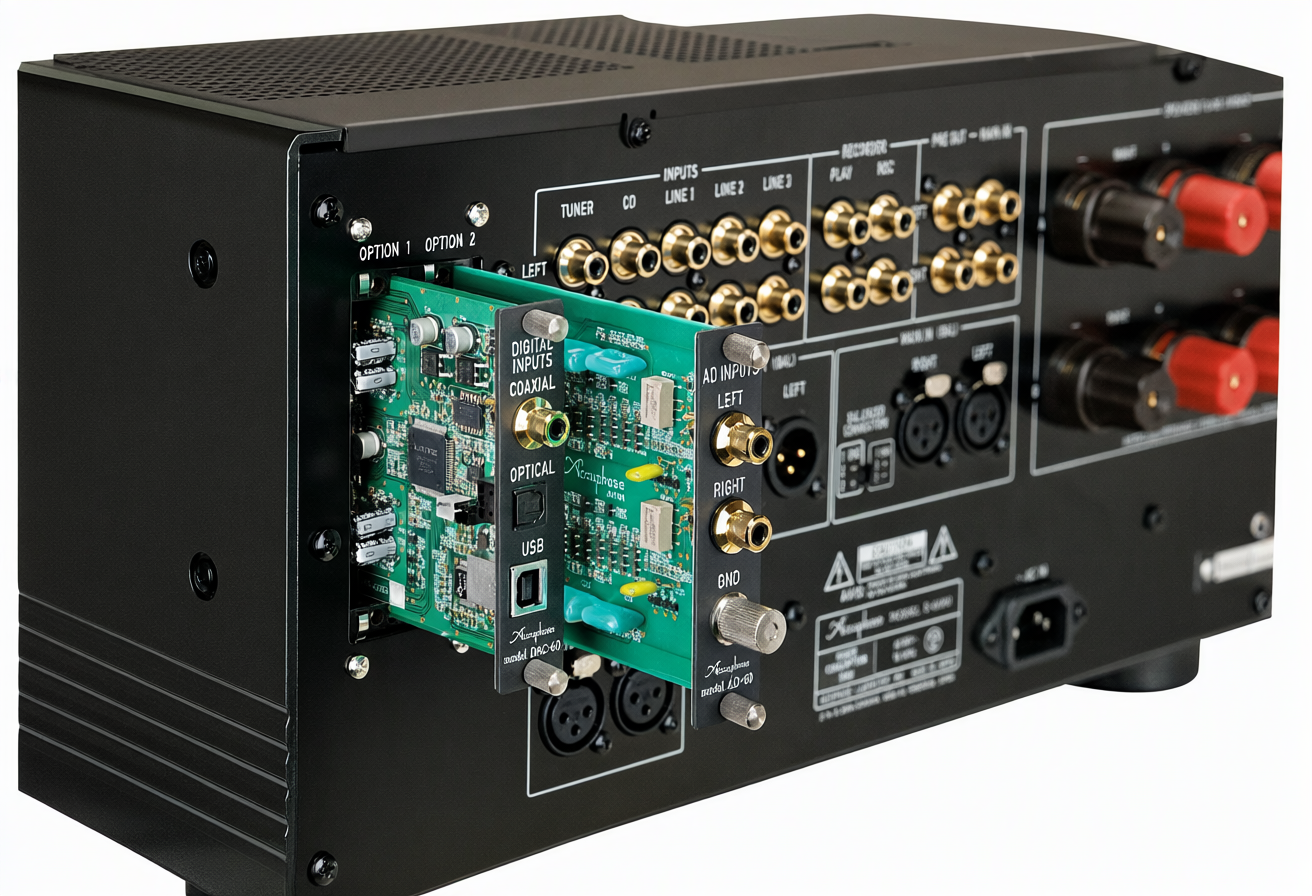
Two rear expansion slots accept optional boards for digital conversion or phono amplification. Those facilities depend on installed boards and are not standard digital or cartridge inputs on an unexpanded amplifier. The front panel includes controls that work with compatible options, such as cartridge-type selection or digital-input selection, keeping their operation within the same amplifier interface.
More than an output increase
The front panel retains analogue power meters and also provides a headphone connection served by a dedicated discrete amplifier. Speaker selection and individual input-phase settings add practical controls around the main signal path. These functions sit within a chassis weighing 38.6 kg, with the supplied photographs showing the front controls, rear connections and internal separation of the power stages and supply.
The E-6000’s development is clearest when the changes are considered together. An extra parallel output pair, larger transformer and increased capacitance address the power section. ANCC addresses the Balanced AAVA circuit. The expansion slots retain a separate route for adding sources, so the new amplifier’s story includes both increased rated output and changes to how its level-control stage operates.
Specifications
| Specification | Details |
|---|---|
| Type / class | Stereo Class AB integrated amplifier |
| Power output | 260 W per channel into 8 ohms; 350 W into 4 ohms; both channels driven, 20 Hz–20 kHz |
| Inputs | 5 RCA line and 2 balanced; separate balanced/line power-amplifier inputs; 2 optional-board slots |
| Outputs | Speaker terminals; balanced and line preamplifier outputs; headphones |
| Frequency response | Integrated inputs: 20 Hz–20 kHz (+0/−0.5 dB) at rated output; main input: 3 Hz–150 kHz (+0/−3 dB) at 1 W |
| Signal-to-noise ratio | Integrated balanced/line inputs: 112 dB; main inputs: 126 dB (rated output, input shorted, A-weighted) |
| THD (distortion) | 0.05%, 4–16-ohm load, rated output, both channels driven, 20 Hz–20 kHz |
| Input impedance / sensitivity | Balanced/line: 40/20 kohms; integrated-input sensitivity 229 mV, main input 1.82 V at rated output |
| Dimensions (H × W × D) | 221 × 465 × 502 mm maximum |
| Weight | 38.6 kg net |
| Damping factor | 1,000 |