
Bowers & Wilkins
HTM2D.
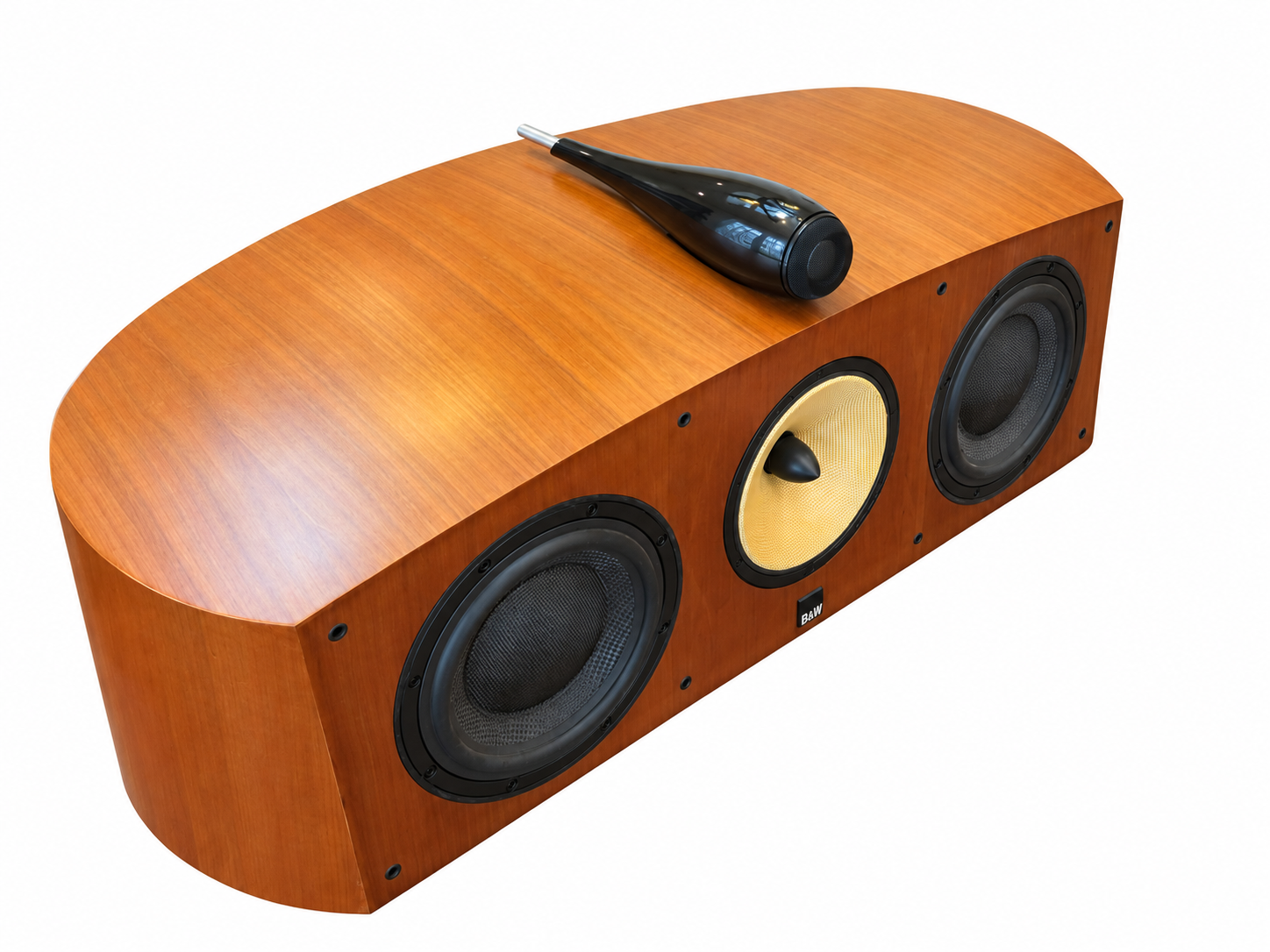
The Bowers & Wilkins HTM2D puts the original 800 Series’ diamond tweeter and dedicated FST midrange into a three-way centre speaker, with two bass drivers and twin rear-facing ports.
The Bowers & Wilkins HTM2D is a three-way centre loudspeaker from the original 2005 800 Series. It brings the range’s diamond tweeter, Kevlar FST midrange and Rohacell bass-cone construction into a horizontal centre-channel cabinet. B&W designed it to partner the 803D, while also identifying it as an option with the larger 802, 801 and 800 models when space prevents using the larger centre speaker.
A dedicated midrange at the centre
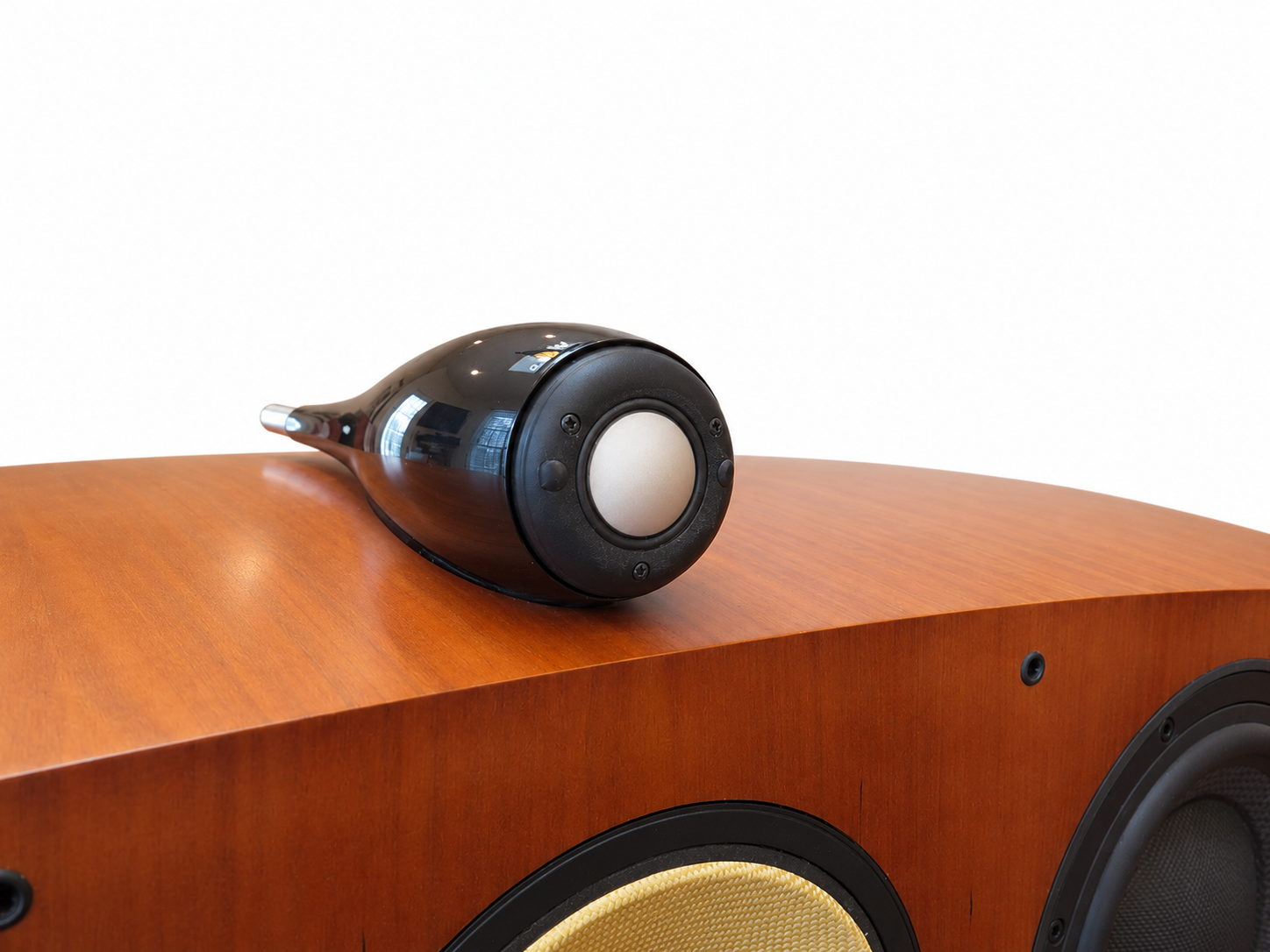
The layout separates the frequency duties between three driver types. A 25 mm diamond tweeter sits in its own housing above the main cabinet. Inside the cabinet, a centrally positioned 150 mm woven-Kevlar FST midrange is flanked by two 180 mm bass drivers. The dedicated midrange is therefore separate from both the bass pair and the tweeter, rather than a combined bass/mid driver handling the centre frequencies.
The FST midrange uses woven Kevlar and a fixed suspension. According to B&W, the material and suspension are intended to control cone behaviour and dispersion through the midrange. Its design approach differs from the rigid diamond tweeter and sandwich bass cones: the development account treats the requirements of each frequency range separately.
What changed in the 2005 series
In the 2005 series announcement, B&W identified diamond domes as a new feature of the six upper D-suffix models. The company retained its earlier Nautilus tube-loading principle, so the new diaphragm material was combined with an existing approach to managing the rear of the tweeter. The HTM2D belongs to that original series, rather than a later HTM2 Diamond or D3/D4 generation.
B&W states that diamond’s stiffness is intended to keep dome movement close to piston-like behaviour through the audible band. Its stated first-breakup figure around 70 kHz describes the dome’s mechanical behaviour. The complete HTM2D has a separately specified response of 41 Hz–28 kHz, ±3 dB on its reference axis; the two figures describe different aspects of the design.
Cabinet and bass construction
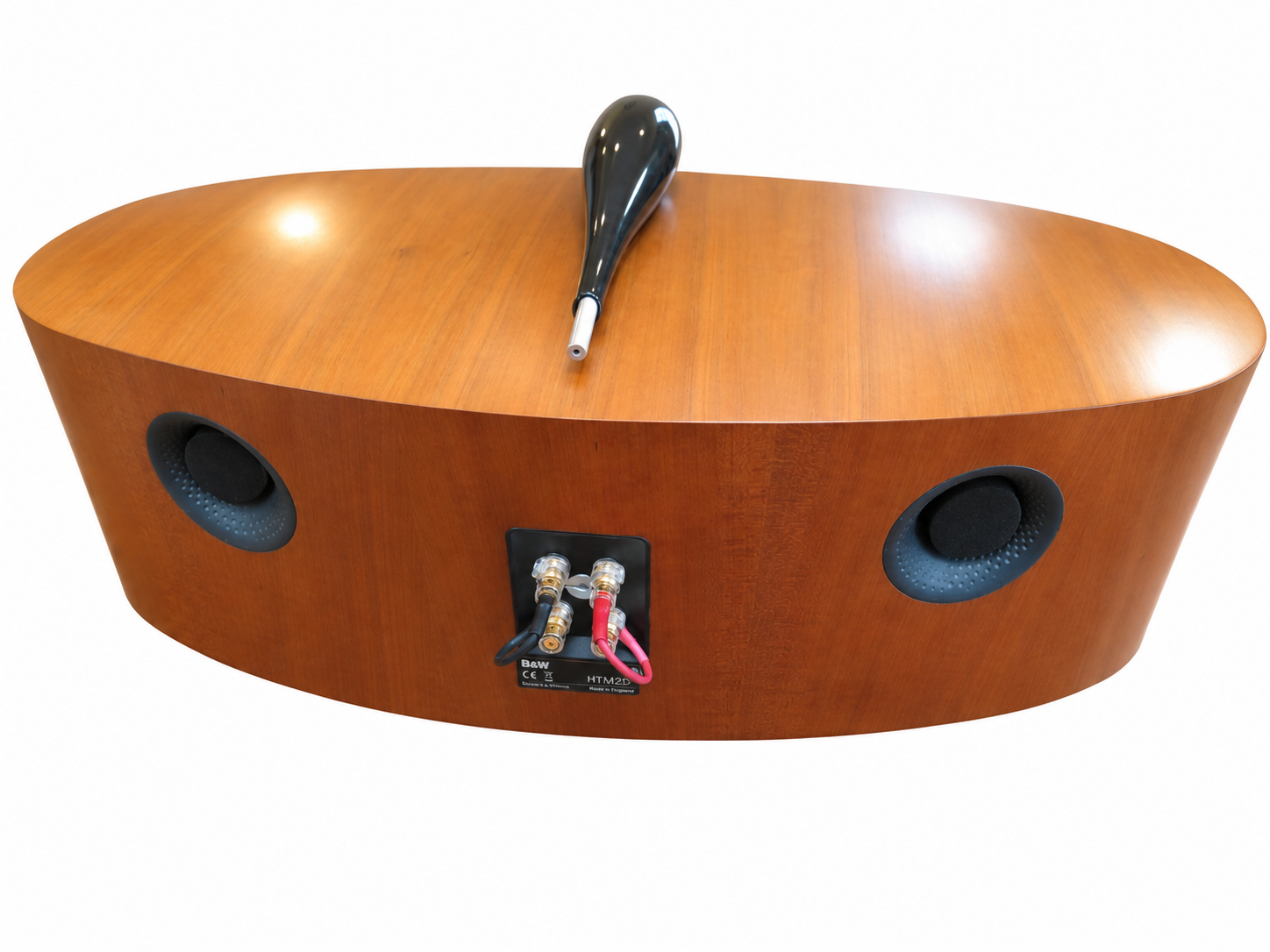
Matrix bracing supports the main cabinet. B&W describes the internal grid as a way of limiting panel vibration, while the separate tweeter housing remains a distinct part of the structure. The construction combines the horizontal enclosure needed for a centre speaker with technologies used elsewhere in the original 800 Series.
The Rohacell bass cones use a foam core between carbon-fibre skins. B&W’s development document explains its choice in terms of rigidity and limiting unwanted sound from inside the enclosure passing back through the cone. The two rear-facing Flowports are another part of the bass system, giving the HTM2D a different port arrangement from the 803D’s front port and the 800D’s downward-facing port.
Amplifier matching
The crossover frequencies are 350 Hz and 4 kHz. B&W lists sensitivity as 90 dB SPL at 2.83 V / 1 m, with nominal impedance of 8 Ω and a 3.1 Ω minimum. Recommended amplification is 50–300 W into 8 Ω with unclipped programme, preserving the manufacturer’s operating conditions rather than treating the upper number as a constant power requirement.
Placement and support
The original information sheet highlights magnetic shielding for placement near CRT televisions and rear projectors. That reflects the display technology in use when the speaker was launched. The same sheet describes use on a suitable shelf or the optional FS-HTM stand, rather than making the stand part of the standard speaker specification.
The FS-HTM offers 0°, 4° or 8° upward tilt, allowing the speaker’s angle to be directed towards the listening position. B&W describes the stand’s low supporting height as suitable for large projector screens extending close to the floor. It is a specific placement provision for the centre channel, not an adjustment to the speaker’s crossover or driver alignment.
The cabinet measures 329 × 841 × 387 mm in height, width and depth and weighs 31 kg. Those figures are relevant to the support platform and load rating when choosing a shelf or stand. Factory finish options listed for the original model are Cherrywood, Rosenut and Black Ash.
Specifications
| Specification | Details |
|---|---|
| Type / design | Three-way vented-box centre speaker |
| Tweeter | 25 mm diamond dome |
| Midrange | 150 mm woven-Kevlar FST cone |
| Woofers | 2 × 180 mm Rohacell cones |
| Frequency response | 41 Hz–28 kHz, ±3 dB on reference axis |
| Sensitivity | 90 dB SPL (2.83 V, 1 m) |
| Nominal impedance | 8 Ω nominal; 3.1 Ω minimum |
| Recommended amplifier power | 50–300 W into 8 Ω on unclipped programme |
| Crossover frequency | 350 Hz and 4 kHz |
| Dimensions (H × W × D) | 329 × 841 × 387 mm |
| Weight | 31 kg per speaker |
| Finishes | Cherrywood, Rosenut, Black Ash |