
Gryphon
Diablo 333.
Apex output devices, a larger supply and a balanced relay volume circuit bring Gryphon’s flagship design ideas into the Diablo 333 integrated amplifier.
Twenty output transistors link the Gryphon Diablo 333 to a much larger amplifier. Ten devices in each channel are the same type used in the flagship Apex. The integrated model brings those parts together with a revised supply, new pre-driver transistors and a balanced relay volume control, continuing a design story established by the Diablo 300.
Introduced in 2023 and designed and built in Denmark, the Diablo 333 combines preamplifier and stereo power-amplifier functions in one enclosure. Gryphon identifies the Apex and Commander as sources of technology and design ideas. The result retains the Diablo name while changing the output devices, supply capacity, controls and provision for optional source modules.
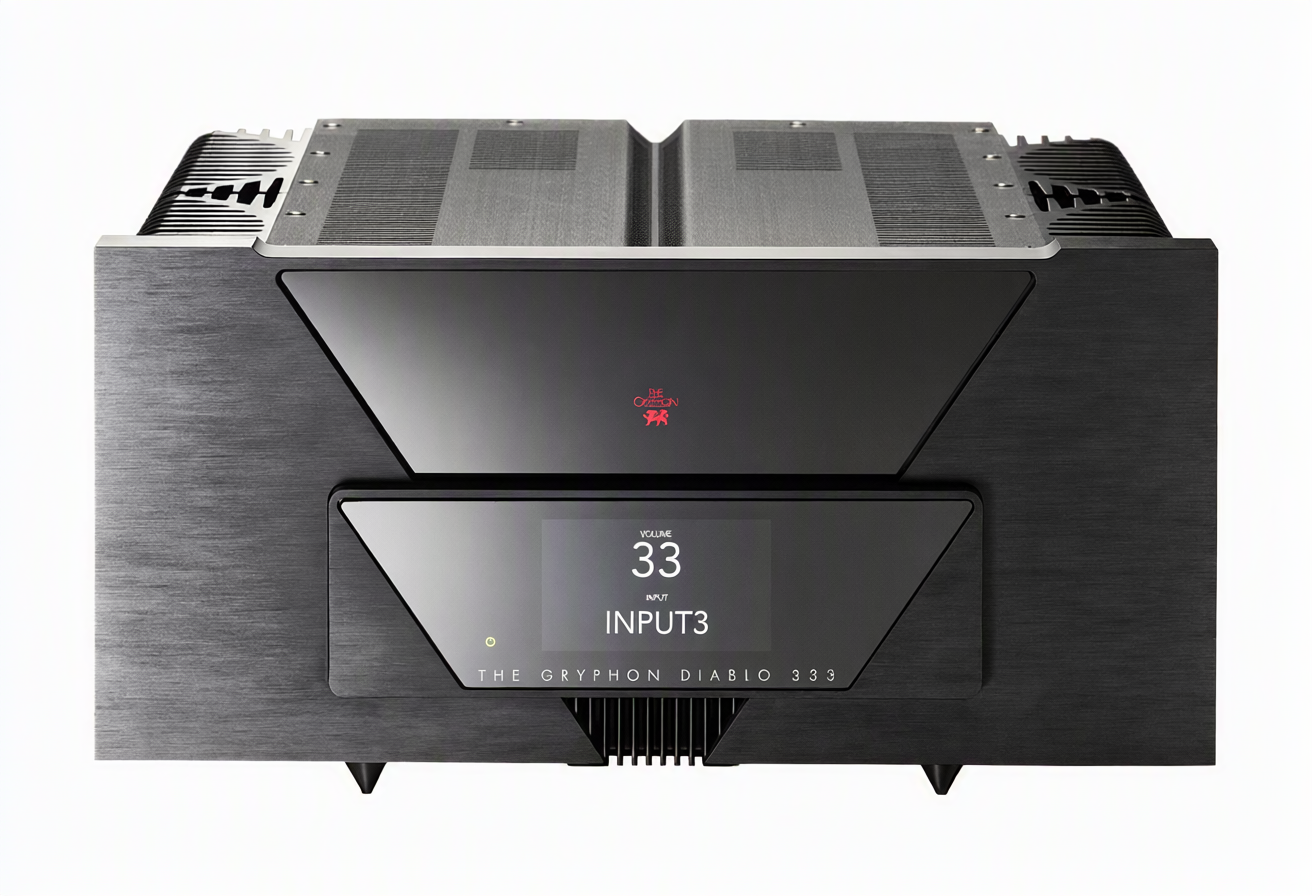
What sits behind the power rating
Gryphon rates the amplifier at 333 watts per channel into 8 ohms, 666 watts into 4 ohms and 1,100 watts into 2 ohms. These are the company’s stated ratings for the respective loads. The supply uses a dual-mono Holmgren toroidal transformer and 68,000 microfarads of filtering per channel, alongside the revised output-stage circuitry.
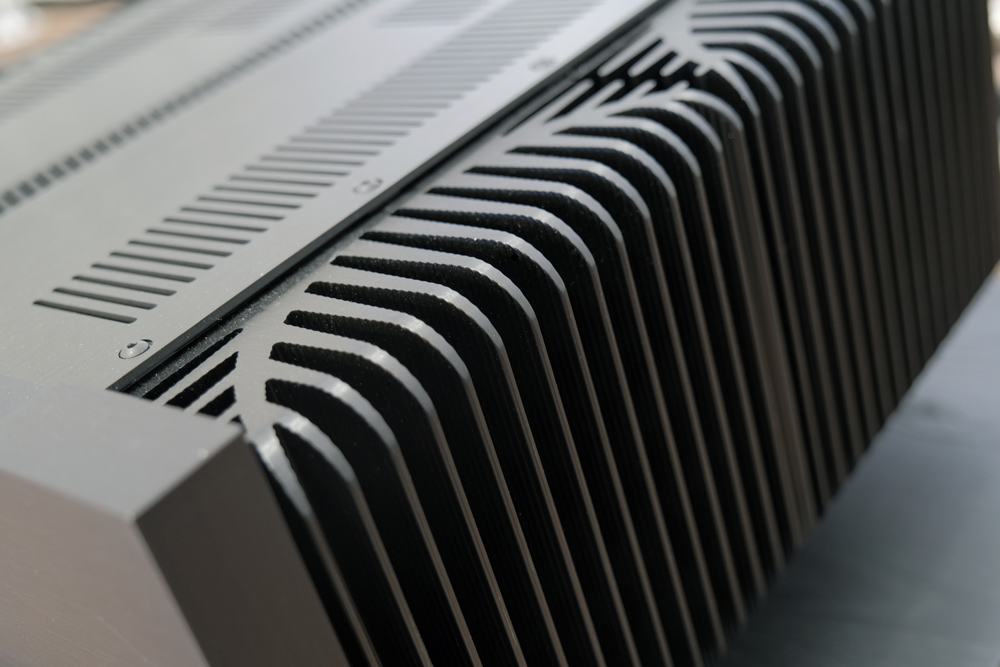
The pre-driver transistors are described as faster, low-capacitance devices. Gryphon combines them with local shunt regulation, polypropylene capacitors for local decoupling and a circuit using no global negative feedback. Its stated approach is to keep signal paths short, with limited internal wiring and sockets mounted to circuit boards. The large side heatsinks form a visible part of the enclosure.
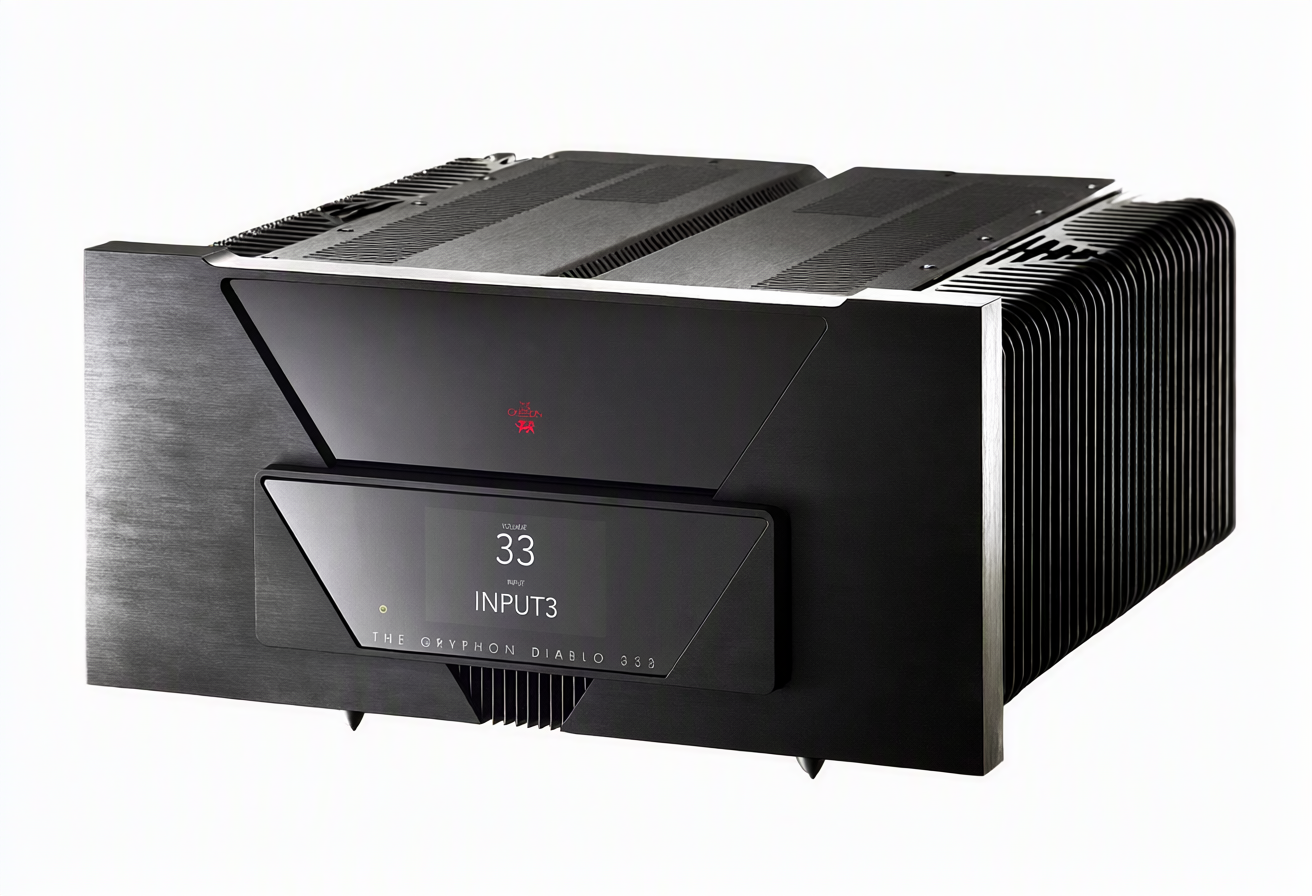
Volume control without a digital audio stage
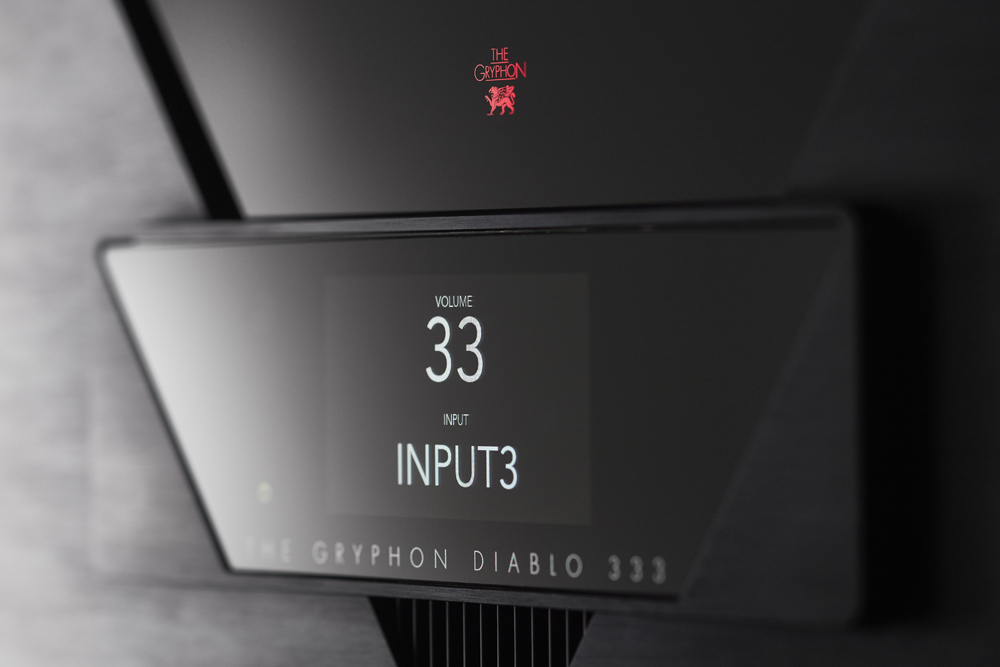
The front touchscreen operates a 43-step balanced relay attenuator. Gryphon specifies that only one or two resistors sit in series with the signal at any volume setting. The screen is therefore the user interface for an analogue attenuation circuit. Input naming, level matching and configurable start and maximum volume settings are available through the menu.
A 4.3-inch capacitive display sits within the triangular front panel. The metal remote handset follows the Commander design, replacing the earlier Diablo 300 remote. Display brightness and automatic dimming can be selected, while a rear USB socket is provided for firmware updates. That socket is separate from the audio inputs offered by an optional DAC module.
Connections for a larger system
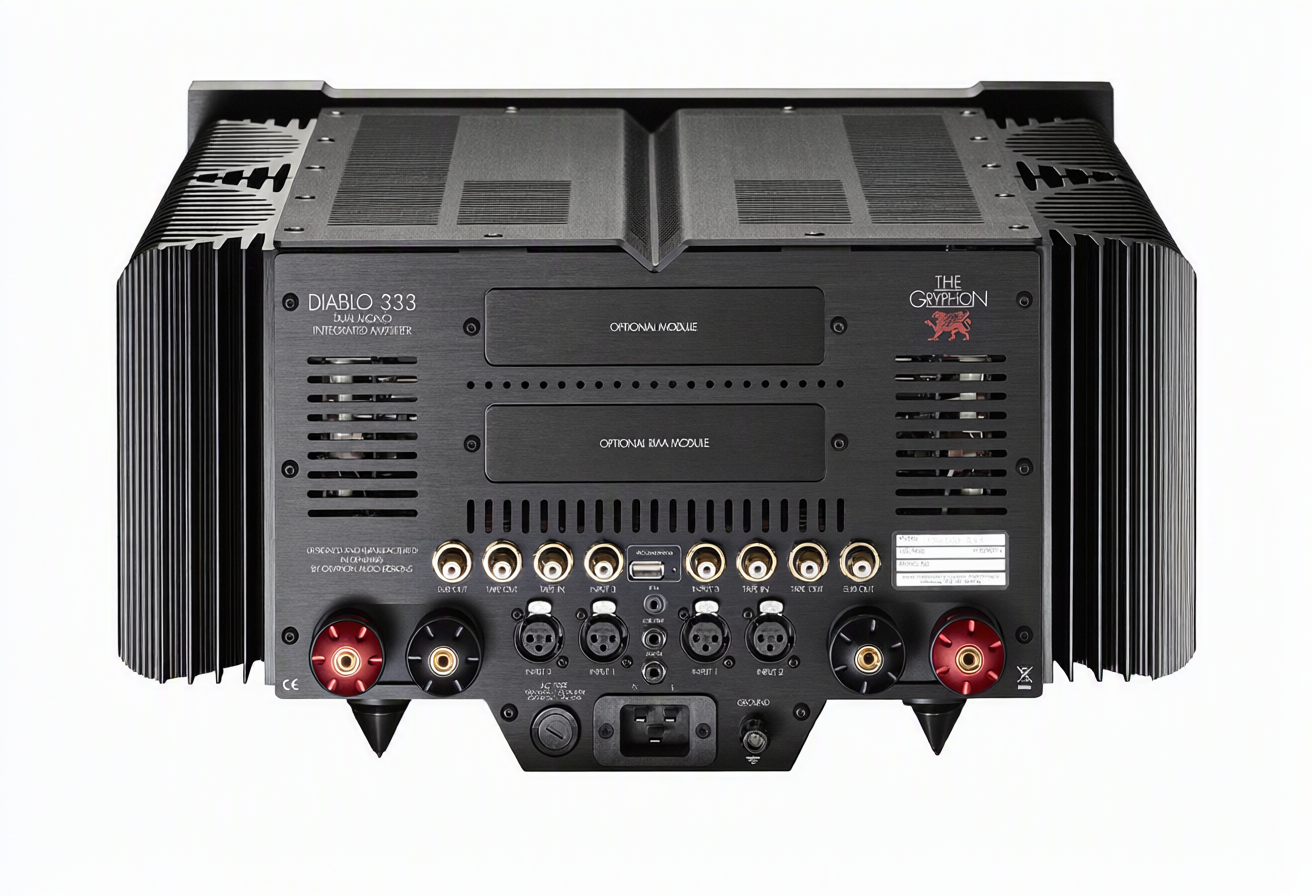
Two balanced XLR inputs and two single-ended RCA inputs provide the standard analogue connections, including the tape input. A selected XLR or RCA input can operate as a fixed-level home-cinema throughput. This allows a surround processor to feed the amplifier through the designated connection, with its behaviour set in the menu rather than by changing the amplifier’s basic role.
The rear panel also provides subwoofer outputs and a tape loop. Gryphon’s custom loudspeaker terminals draw on the Apex design. These connections expand how the integrated amplifier fits into a system beyond straightforward source-to-speaker operation. The rear-panel photograph shows the standard analogue configuration, so the digital and phono facilities remain optional additions rather than installed features of this unit.
Optional sources, separate decisions
The PS3 phono module and DAC3 digital module were redesigned for this generation. Gryphon specifies balanced XLR connections for the phono option and an ESS ES9039PRO converter for the DAC option. Their facilities depend on the relevant module being fitted. Neither the amplifier’s standard line inputs nor its firmware socket turn the base unit into a phono stage or USB DAC.
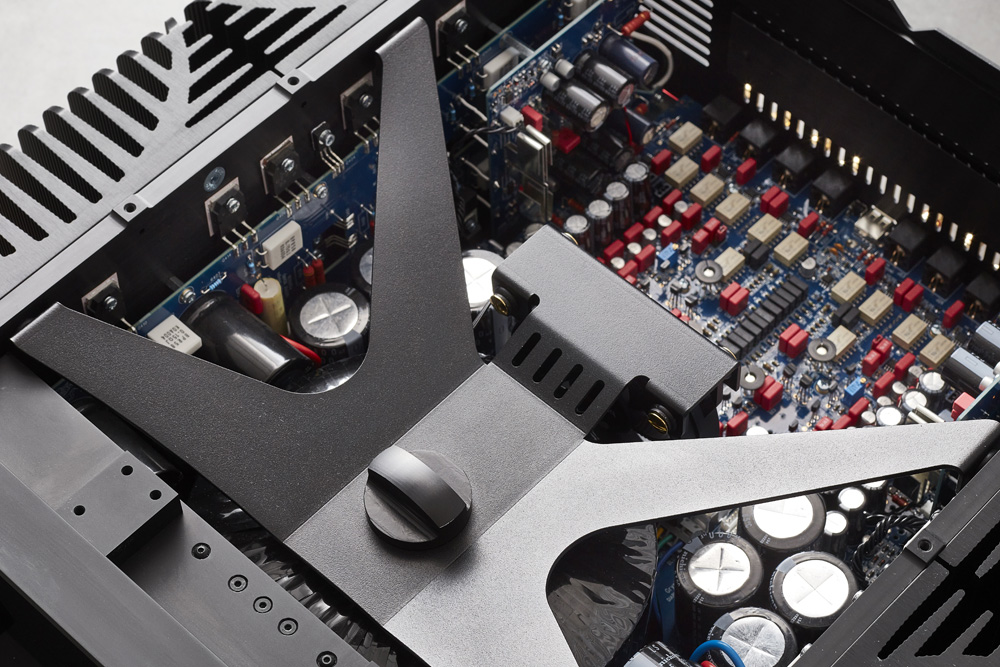
An integrated with flagship connections
At 50.6 kg, the Diablo 333 houses its power supply, stereo amplification and relay-controlled preamplifier in a single chassis. Its relationship to the Diablo 300 is visible in the overall concept, while the Apex-derived devices and Commander-style controls identify the development. The defining changes concern actual circuitry and operation, with the optional modules extending the sources that the same enclosure can accommodate.
Specifications
| Specification | Details |
|---|---|
| Type / class | Dual-mono stereo integrated amplifier; Class AB |
| Power output | 333 W per channel into 8 ohms; 666 W into 4 ohms; 1,100 W into 2 ohms (manufacturer ratings) |
| Inputs | 2 balanced XLR; 2 RCA including tape input; optional phono and DAC modules |
| Outputs | Speaker terminals; subwoofer outputs; tape output |
| Frequency response | Bandwidth: 0.1 Hz–350 kHz (−3 dB) |
| Input impedance / sensitivity | Balanced: 50 kohms; single-ended: 30 kohms (20 Hz–20 kHz); gain +38 dB |
| Dimensions (H × W × D) | 245 × 468 × 472 mm |
| Weight | 50.6 kg |
| Volume control | 43-step balanced relay attenuator |