
McIntosh
MA2375.
Twelve valves, Unity Coupled output transformers and screen-grid sensing mark McIntosh’s return to the all-valve integrated amplifier.
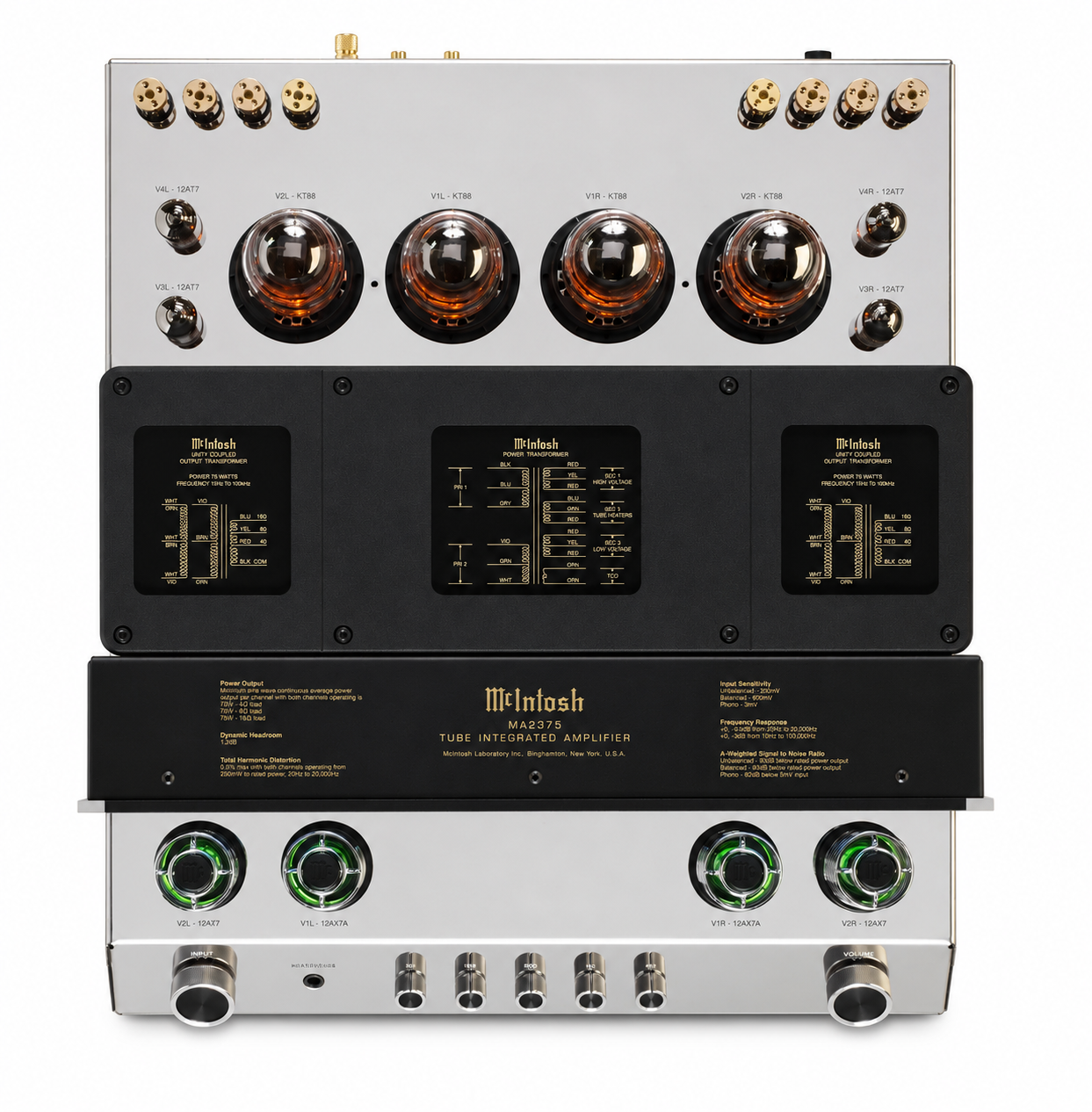
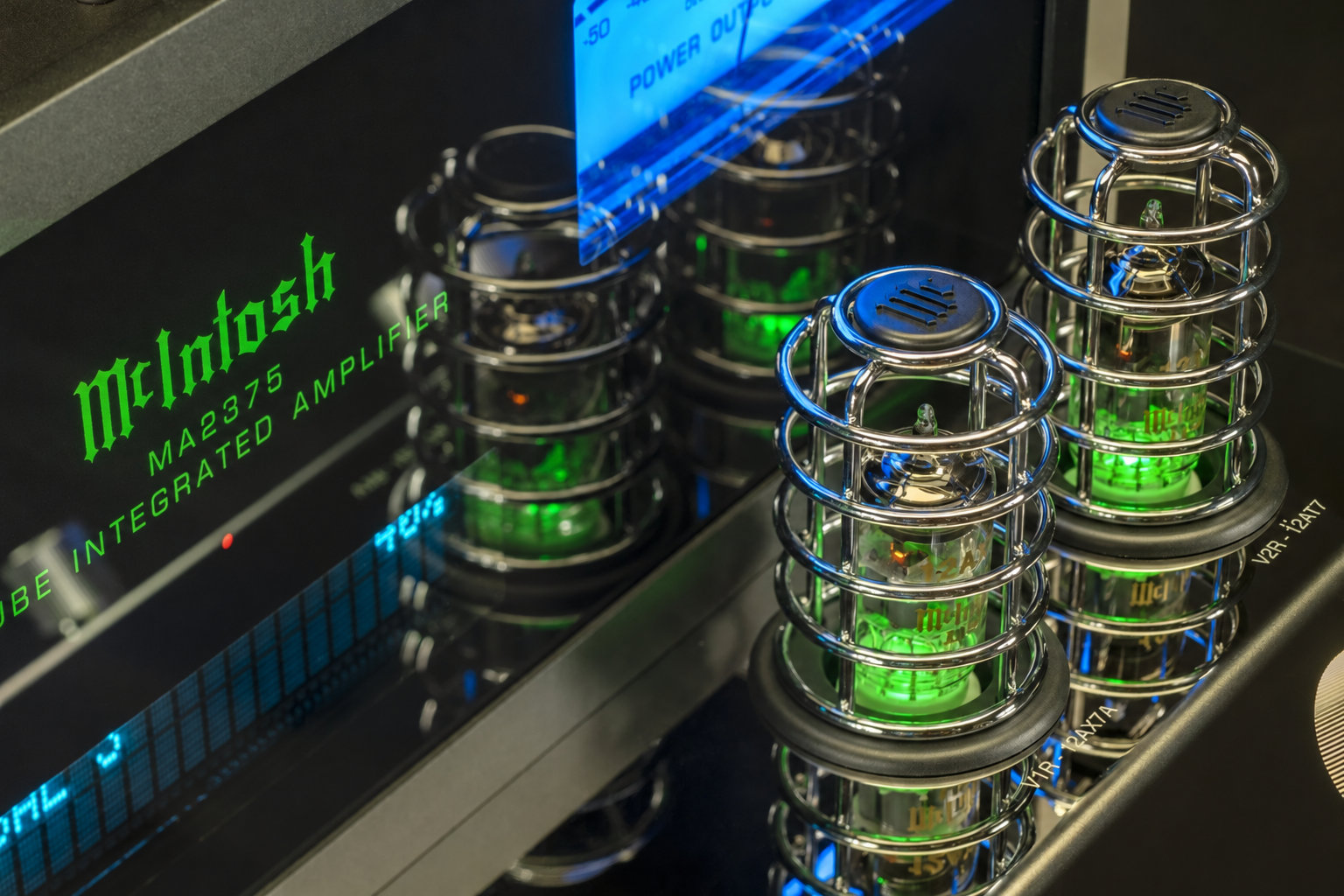
Twelve valves occupy distinct roles in the McIntosh MA2375. Four KT88s form the output stage, four 12AT7s drive that stage, and another four valves serve the preamplifier. This is an all-analogue integrated amplifier with valves in both amplification sections, bringing source control and stereo power amplification into one chassis with the familiar pair of blue watt meters.
McIntosh describes the MA2375 as its first vacuum-tube integrated amplifier in more than a decade. It follows the earlier MA2275, manufactured between 2004 and 2011. The newer design combines that established product concept with a five-band equaliser, moving-coil cartridge support and screen-grid current monitoring. Its model-specific rear plate identifies manufacture in the USA with US and imported parts.
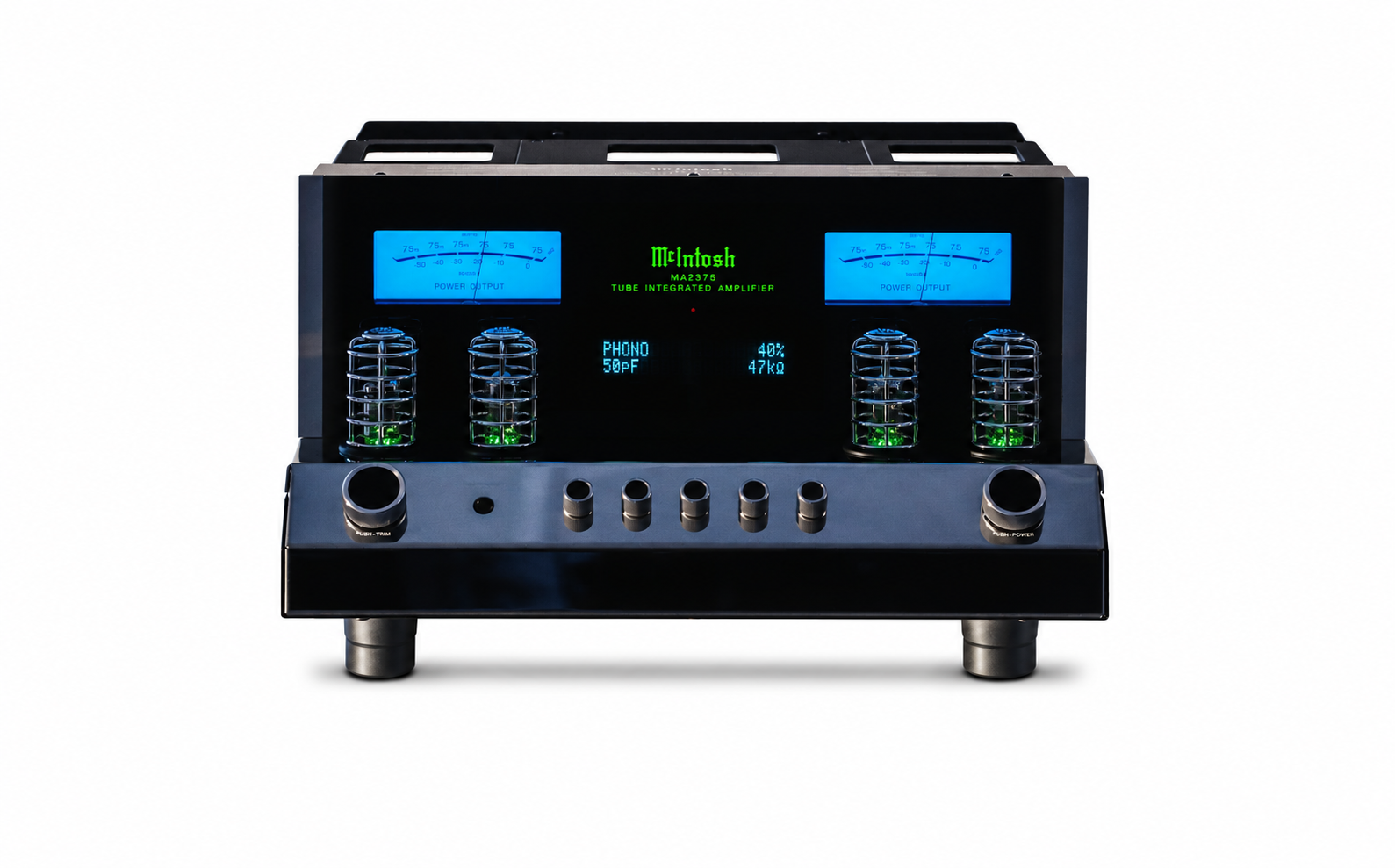
The transformers define the output
The MA2375 is rated at 75 watts per channel into 4, 8 or 16 ohms through Unity Coupled output transformers. Matching speaker terminals are provided for the specified impedances. The output transformers are integral to the valve power stage, rather than the Autoformers associated with some other McIntosh amplifiers. The published power band extends from 20 Hz to 20 kHz.
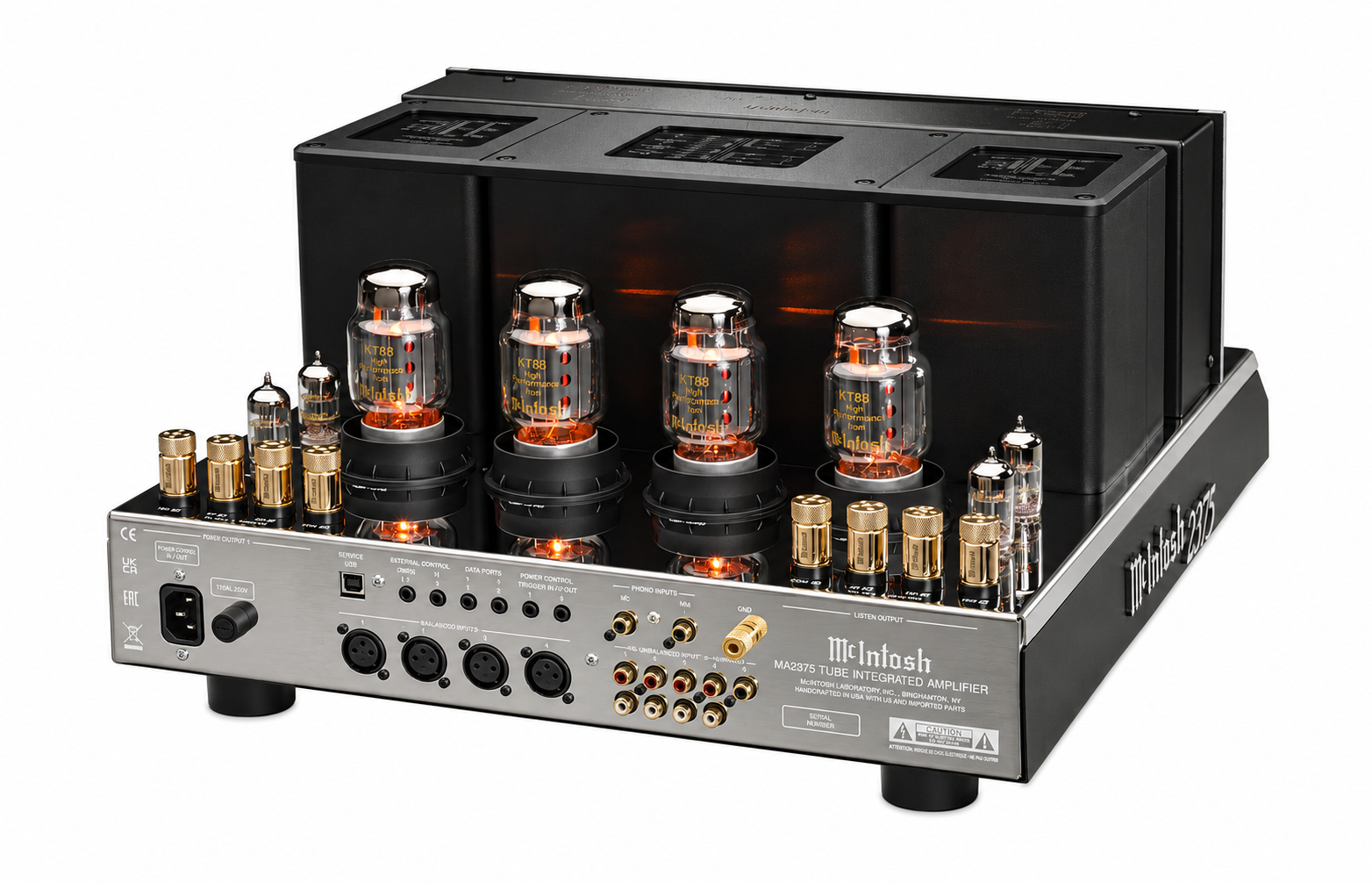
Behind the KT88 output valves, the power-stage driver complement is four 12AT7s. The preamplifier uses two 12AX7As and two more 12AT7s. Separating these roles explains the twelve-valve total and the amplifier’s overall arrangement. The visible valve bank belongs to a complete integrated design, with the input selection, tone controls and output stage contained in the same enclosure.
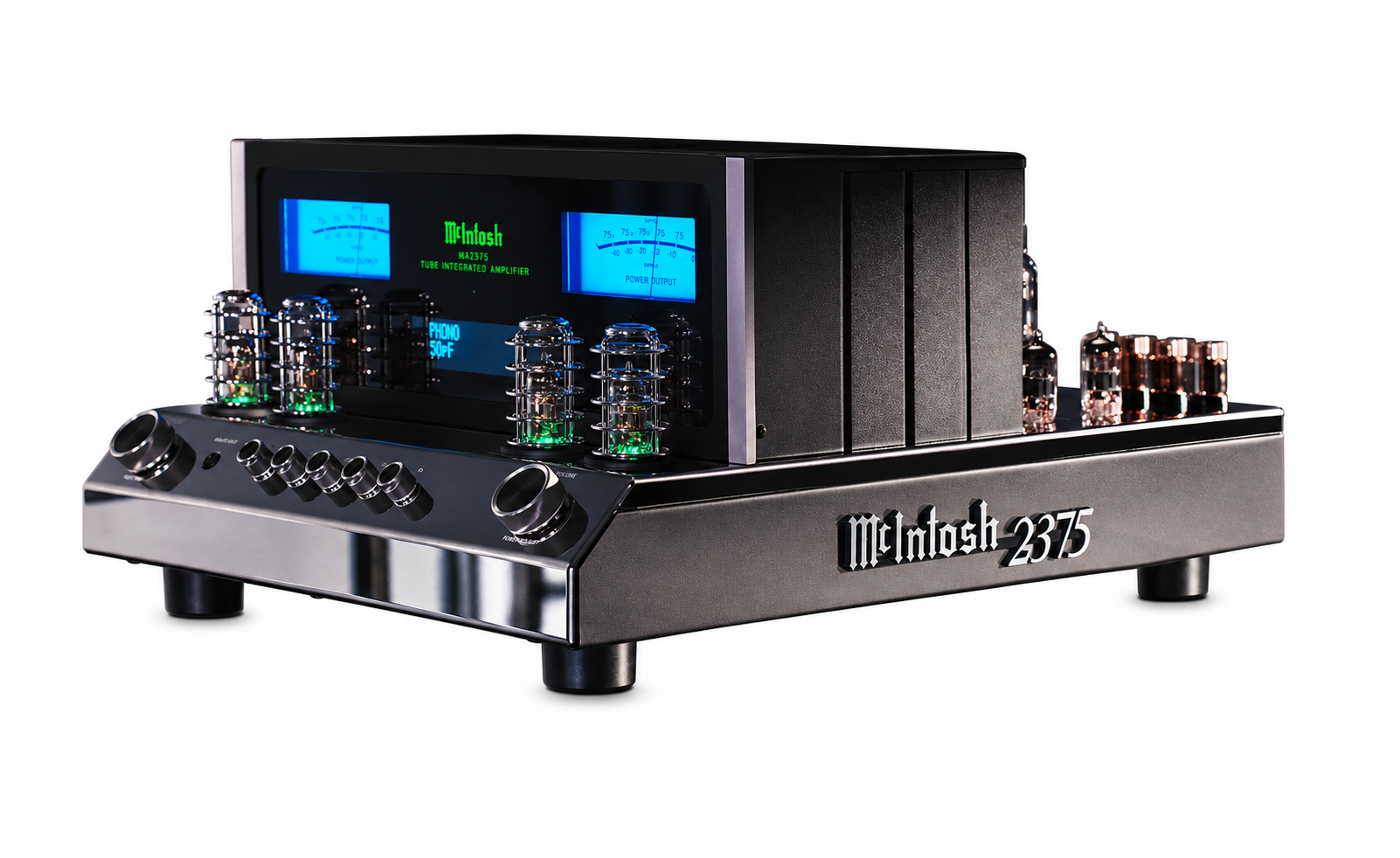
A safeguard for the glowing valves
Power Guard Screen Grid Sensor monitors current in the output valves’ screen grids. If that current becomes excessive, the circuit attenuates the input signal. McIntosh describes this as protection for the output valves. It is a defined response to a particular electrical condition, with the input reduction controlled by the monitoring circuit rather than by the user’s volume adjustment.
Sentry Monitor provides a separate, fuse-less short-circuit protection function. The two systems therefore address different conditions within the amplifier. The front meters display output power, while the protection circuitry operates alongside the amplification stages. McIntosh combines these arrangements with its Solid Cinch speaker terminals, which secure the loudspeaker connections on the rear panel.
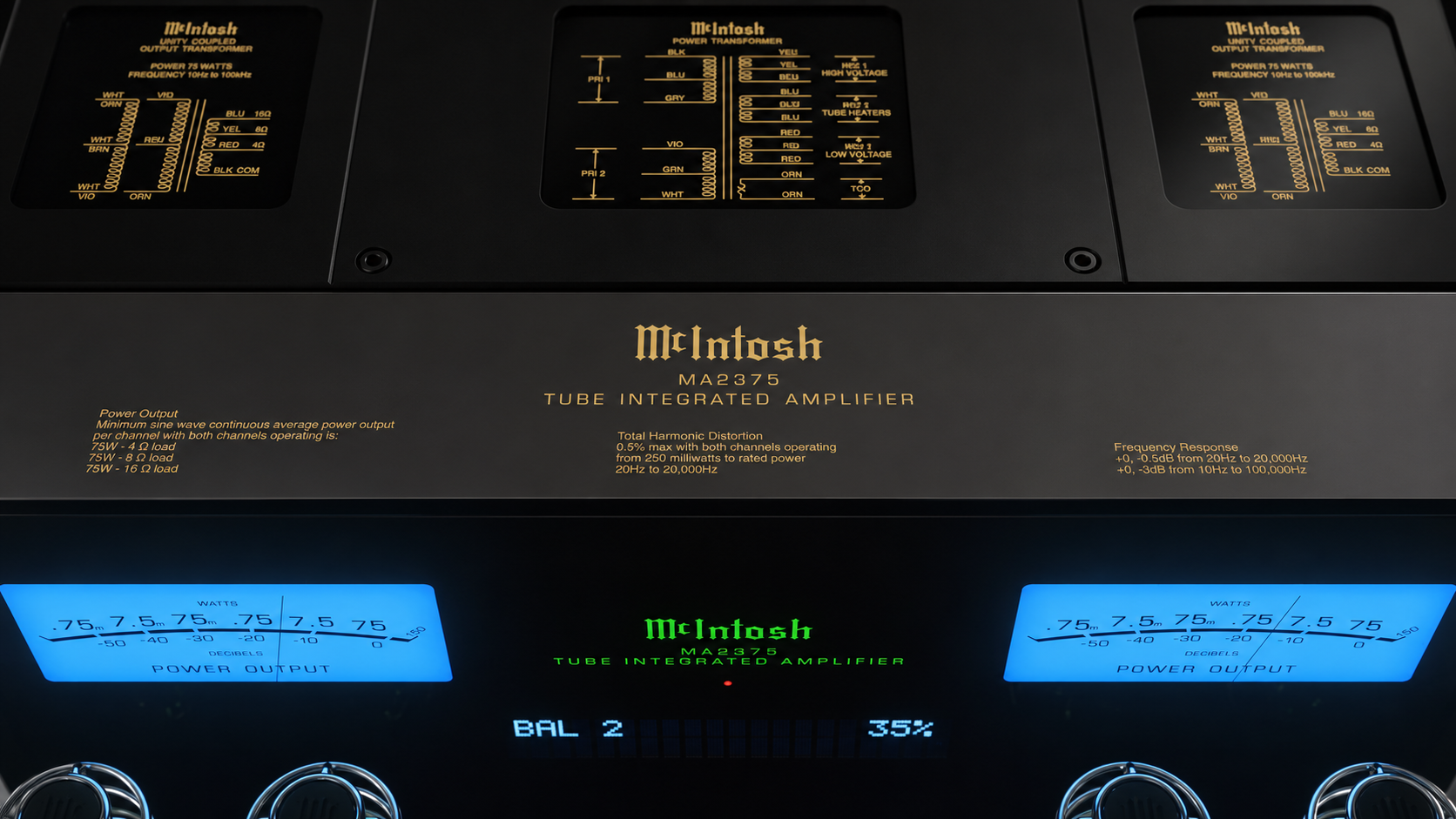
An analogue source hub
Six analogue inputs comprise two balanced connections, three unbalanced line inputs and a configurable phono input. The phono section accommodates moving-magnet and moving-coil cartridges, with adjustable gain, resistance and capacitance. This extends the cartridge options beyond the moving-magnet provision of the earlier MA2275. A separate DAC or streamer can feed one of the line inputs through its analogue output.
The five-band analogue equaliser replaces the earlier model’s simpler bass and treble controls. It can be bypassed and assigned by input, allowing different sources to retain their own settings. A subwoofer output, variable analogue output and home-theatre passthrough extend system integration. The front headphone connection includes McIntosh’s High Drive amplifier and selectable Headphone Crossfeed Director.
The familiar face, revised facilities
The polished stainless-steel chassis and blue meters place the MA2375 within McIntosh’s visual tradition. Remote control, power-control connections, data ports and RS232 support sit alongside the analogue audio facilities. They add ways of operating a connected system while the preamplifier and power-amplifier signal path remains analogue. The complete amplifier weighs 42.2 kg.
The MA2375 returns to the earlier all-valve integrated idea with specific additions rather than a change to the basic role. Moving-coil support expands the phono section, five-band equalisation expands tonal adjustment, and screen-grid sensing adds output-valve monitoring. Twelve valves and two meters remain visible, but the distinguishing story includes the controls and protection working around them.
Specifications
| Specification | Details |
|---|---|
| Type / class | Stereo all-valve integrated amplifier |
| Power output | 75 W per channel into 4, 8 or 16 ohms; rated power band 20 Hz–20 kHz |
| Inputs | 2 balanced line; 3 unbalanced line; 1 configurable MM/MC phono |
| Outputs | Speaker terminals for 4, 8 and 16 ohms; variable analogue output; subwoofer output; headphone output |
| Frequency response | 20 Hz–20 kHz (+0/−0.5 dB); 10 Hz–50 kHz (+0/−3 dB) |
| Signal-to-noise ratio | High level: 95 dB; MM and MC phono: 75 dB |
| THD (distortion) | 0.5% maximum, both channels operating from 250 mW to rated power, 20 Hz–20 kHz |
| Input impedance / sensitivity | Balanced/unbalanced line: 44/22 kohms and 600/300 mV; phono loading 100 ohms–47 kohms and 50–400 pF |
| Dimensions (H × W × D) | 252 × 452 × 519 mm |
| Weight | 42.2 kg |
| Valves | Output: 4 × KT88; power-stage drivers: 4 × 12AT7; preamplifier: 2 × 12AX7A and 2 × 12AT7 |